Showing posts with label system heavy. Show all posts

Wednesday, October 21, 2020

System Review: AGON


AGON is a fantasy-action TTRPG created by John Harper (Blades in the Dark) and Sean Nittner from Evil Hat Productions. Players take on the roles of heroes in Ancient Greek myths and legends, as they return from war and find themselves sailing through a mist-covered sea, traveling from island to island as they face new challenges and the whimsies of the Olympians.

For full reference, my experience playing AGON is through Roll20 in weekly games, where I took on both a player and a GM role.

Conclusion

Just to get it out of the way as it's what most people reading reviews are actually looking for: I enjoy AGON and would recommend trying it out for an island or two. AGON will appeal if you:
  • Like narrative driven games with a focus on minimal and decisive dice rolling
  • Like Ancient Greek thematics (or any other setting with a strong focus on capricious supernatural forces and competition, such as Norse mythology)
  • Like games that require minimal prep work for a GM, or games where players can take turns as the GM
  • Like episodic adventures, or systems that work well as one shots
However, it may not appeal if you:
  • Like games with a heavier focus on tactics, battlemaps etc.
  • Like to take time discussing and planning out your next moves
  • Like more involved combat systems

Also, the artwork is lovely and thematic. The full page art before each adventure is a wonderful addition, and the game is all the better for it.

Wednesday, August 5, 2020

Aarakocra: Nope No Longer

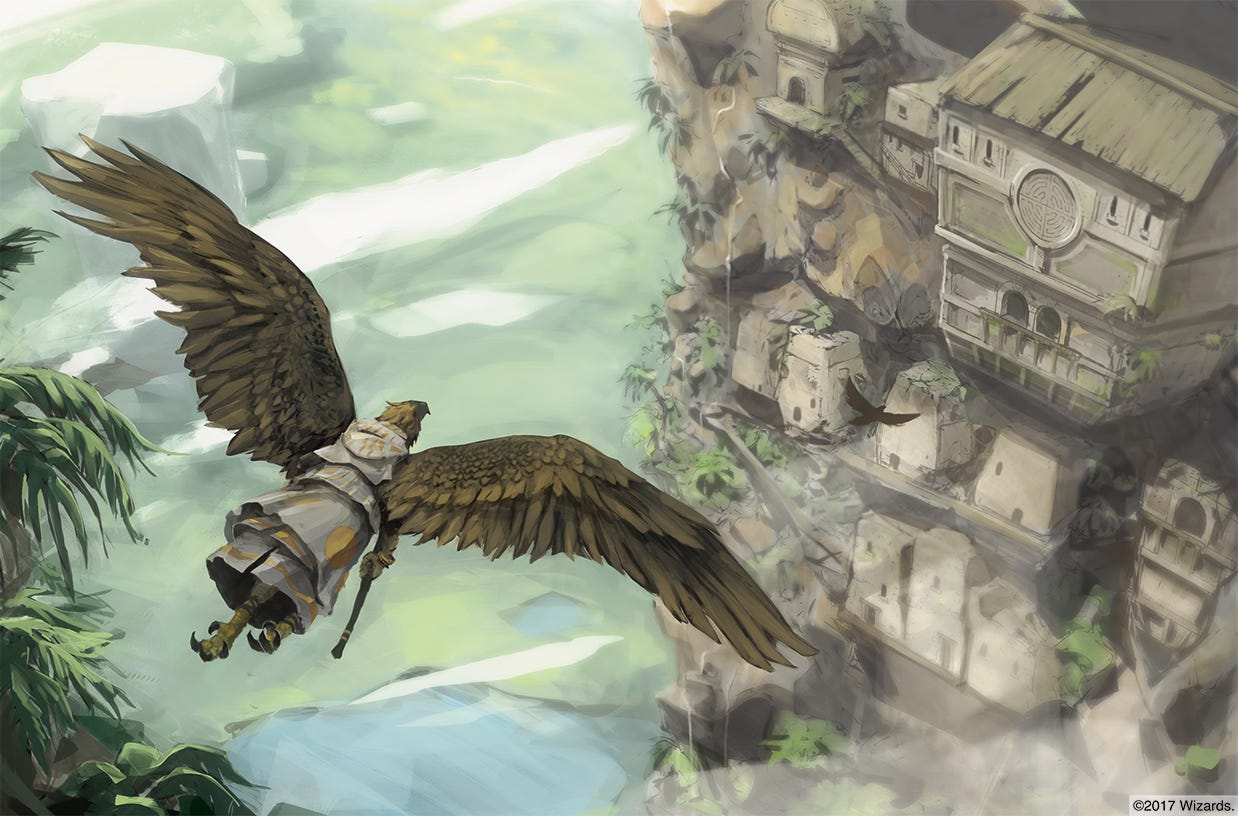
Aarakocra art from Tomb of Annihilation (2017)

this post specifically deals with 5th edition Dungeons and Dragons content.

Bird people are a cool concept. They combine the speed, gracefulness, keen eyesight, and predatory drive of a raptor with thumbs. Wizards of the Coast exploited this niche with the introduction of aarakocra as a player race, added to 5th edition in Princes of the Apocalypse. These hexapodal avians became the first player race in 5e to have an innate flying speed - giving them 50 ft of flight, provided they aren't wearing medium or heavy armour.

Since then they have been systematically banned from almost every D&D table I've sat at and every online game I've taken part in. The same goes for games across the globe, as the notion of a player race that can move vertically instead of horizontally is declared time and time again to be an unwelcome addition to the game. Personally, I think this is a shame, as aarakocra strike me as such an interesting player option that opens up various doors of gameplay and campaign design to both players and the DM. What's worse, the way that some DMs have gone about trying to "correct" this issue for their tables both completely negates player expectations and is arguably a more work-intensive method of getting the result they initially wanted of not having to deal with aarakocra in the first place.

So, before we "fix" these wonderful bird people, let's ask: "Why do DMs not allow aarakocra in their games?" The answers that I see most often roughly fall into two categories: balance and compensation.

Sunday, April 12, 2020

Homebrew: Underwater Mechanics and 3D combat in Roll20 (D&D 5e)

"There is heroism and brute warfare on the ocean floor, unseen by land-dwellers. There are gods and catastrophes."
~ China Mieville, The Scar
That which lies below the waves is an interesting and terrible place indeed. It is also a great location for stories and campaigns, and as such saddens me that I cannot enjoy it more often. One of the primary reasons for this is due to the additional rulings, which are seen as limitations on characters that want to flex their entire skillset. Personally I am of the belief that these rules should not be seen as limitations, but as demonstrations of the pressures on aquatic life, and as a way to explore how these pressures have been overcome or coexisted alongside.

Below are some rulings that can be used by DMs that want to emphasise the effect of being in an aquatic environment on characters and objects. These rules would also be good to consider for subterranean games, as many underground rivers and sea caves and the like exist below the earth.

Core Rules

Official rules related to underwater gameplay can be found in the following areas:
Player's Handbook: breathing underwater/suffocation (pg 183); underwater combat (pg 198)
Dungeonmaster's Guide: extreme cold, frigid water, high altitude aka effects of pressure (pg 110); swimming (pg 116); underwater visibility (pg 117)
Ghosts of Saltmarsh: ocean environs (pg 202-207); currents, depth illumination (pg 203); pressure and objects (pg 204)

In addition, Appendix A of Ghosts of Saltmarsh includes rules on ships and naval combat; Storm King's Thunder also includes a ruling on damage at 3,000 feet below sea level (pg 203).

Wednesday, March 25, 2020

Demonata

In my childhood I was not always an active reader. That changed drastically around the time that I discovered the works of Darren Shan, an Irish author of horror novels. I got through each book of the Cirque du Freak series and each book of the Demonata series in a book-a-day layout, borderline devouring the pages upon finally finding something that really clicked with me. Throughout my time attempting (and failing) to write prose and as a tabletop game player, Shan's novels have definitively influenced both my creative works and me as a person.

It's therefore kind of a surprise to me that I haven't incorporated much of his worldbuilding into any games. Let's change that.

I'm going to preface this by saying that, as a primarily D&D player, I do not think this system is the best one for capturing the tone and feel of either the Demonata series or the Cirque du Freak series. D&D is a game of heroism, epic feats, and increasing in personal power. These do come into play in Shan's books as well, but rarely to the extent that D&D will give you. The characters are constantly against odds that cannot be fought head on, which eventually, inevitably, becomes the case in many D&D games.

There are ways to get around this- rule modifications, tone, level caps- but I would still recommend people consider other game systems for running games in Shan-inspired settings/tones. Perhaps I'll do a version of this post in a different game system as proof of this at a later time.

As the title of this post suggests, I'm going to focus on the Demonata series. The goal of this post is to outline some of the concepts within the series and then begin translating them mechanically into Dungeons and Dragons so players can use them for themselves. If people like where this goes, I'll add more to it, maybe do some stat blocks and stuff for it too.

Unsurprisingly, spoilers follow after the break.

Saturday, October 5, 2019

What's in a Name?: a Response to UA Onomancy Wizard

Fear Names.
Names have power in identity.
Others can use names as weapons.
Names are a hook that can be used to track you...
Remain nameless, and you shall be safe.
~ Planescape: Torment

Multiple D&D subclasses inform the DM about aspects of their world. A cleric's domain informs what deities or forces are present in the world, as does a warlock's patronage. The presence of glamour bards informs one of the many roles of fey in the world, and draconic ancestry sorcerers inform the potential for bloodlines of humanoids and dragons to intertwine.

This list has been further added to with the most recent UA's addition of the School of Onomancy, a wizard subclass that focuses on the role and control of true names. Their flavour text states:
Something that is named stands out in the multiverse, distinct from the tapestry of creation all around it. That distinction creates power that onomancers seek to tap.
True names - the concept that knowing an individual's name gives you power over them - are found throughout fiction. From the fairytale of Rumpelstiltskin to the multiple applications of true names in White Wolf's World of Darkness games, to the banishment of DC Comics's Mr Mxyzptlk, the power of names comes in many forms and with many depictions. Dungeons and Dragons has used it multiple times in the past, but this has declined since 3rd edition. In 5th edition published content, the arcane usage of true names is mostly limited to flavour text; the most it can be seen mechanically is with devil summoning:
A mortal who learns a devil's true name can use powerful summoning magic to call the devil from the Nine Hells and bind it into service (MM, pg 67)
On each of your turns, you can try to issue a verbal command to the devil (no action required by you). It obeys the command if the likely outcome is in accordance with its desires, especially if the result would draw you toward evil. Otherwise, you must make a Charisma (Deception, Intimidation, or Persuasion) check contested by its Wisdom (Insight) check. You make the check with advantage if you say the devil’s true name. (Infernal calling spell)
Personally, I love the idea of true names. It's an evocative concept that has made its way into multiple forms of fiction, and creates great opportunities for interesting adventures and roleplay. If players want to defeat a powerful enemy, they can go out of their way to seek the villain's true name, learning about their history and the choices they made to get to where they are, then use this knowledge to compel the villain to surrender or change their ways. It also flows in well with the general idea that words and magic are intermingled, as with bards and their songs, paladins and the oaths they swear, and the words of power within the D&D spell list.

I fully support the presence of true names in D&D, and that's why I cannot say I'm the biggest fan of the onomancy wizard.

Sunday, September 8, 2019

Running Ten Candles online: a reflection

These things are true.
The world is dark.
And we are alive.


I am very happy to report that last night I had a successful first time running Ten Candles, a tragic horror one-shot TTRPG written by Stephen Dewey and published by Cavalry Games. In this game, players collaboratively tell the tale of a group of survivors, attempting to do one last act of defiance against the enemy (Them) that will slowly and surely consume them in the darkness. It is very much intended to be a game played in person, with much of the game’s mechanics being linked to the visual display of the game, as ten candles are lit in a circle and each player literally burns their trait cards one by one as they are used up.

I don’t currently have ten candles, a fireproof bowl, or a group of people with time to run this game. I also didn’t want to embarrass myself in front of people by discovering halfway through a game that I can’t do horror very well. With that in mind, I had to improvise, running the game online through Discord and Roll20.

Below isn’t necessarily a full review of the game itself, but instead a reflection on how it went running the game on a digital platform, and what lessons from this session could be brought into future games both on and off the computer.