
AGON is a fantasy-action TTRPG created by John Harper (Blades in the Dark) and Sean Nittner from Evil Hat Productions. Players take on the roles of heroes in Ancient Greek myths and legends, as they return from war and find themselves sailing through a mist-covered sea, traveling from island to island as they face new challenges and the whimsies of the Olympians.
For full reference, my experience playing AGON is through Roll20 in weekly games, where I took on both a player and a GM role.
Conclusion
Just to get it out of the way as it's what most people reading reviews are actually looking for: I enjoy AGON and would recommend trying it out for an island or two. AGON will appeal if you:- Like narrative driven games with a focus on minimal and decisive dice rolling
- Like Ancient Greek thematics (or any other setting with a strong focus on capricious supernatural forces and competition, such as Norse mythology)
- Like games that require minimal prep work for a GM, or games where players can take turns as the GM
- Like episodic adventures, or systems that work well as one shots
- Like games with a heavier focus on tactics, battlemaps etc.
- Like to take time discussing and planning out your next moves
- Like more involved combat systems
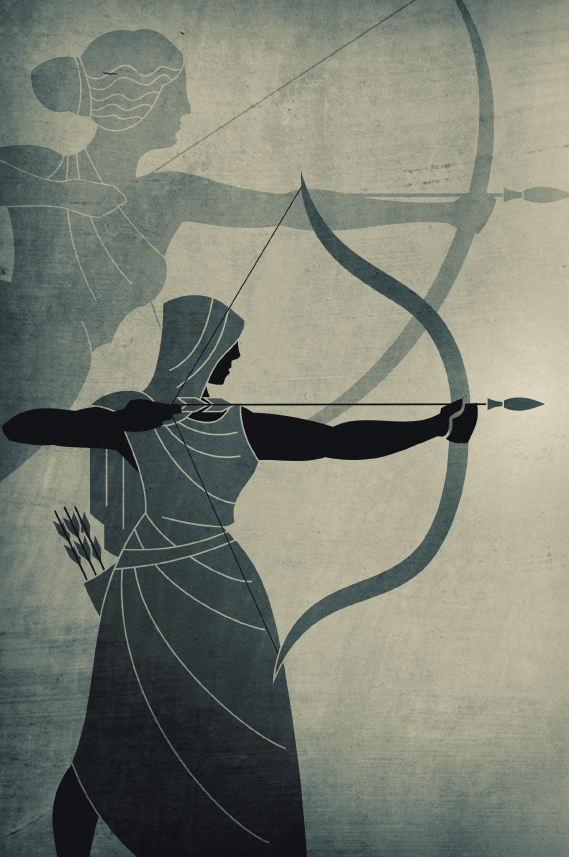
Also, the artwork is lovely and thematic. The full page art before each adventure is a wonderful addition, and the game is all the better for it.
Contests and Battles
AGON's core mechanic is the Contest: the GM (Strife Player) and players (Heroes) step up to face off against each other in a contest. Players then narrate how they failed, how they succeeded, and who was best (who rolled highest), earning Glory (XP) in the process. No matter if you win or lose, you gain Glory of some value regardless. At the end of an adventure, the group goes to Battle: a three stage conflict to claim victory over the island's challenge, or to sail away in defeat.
Due to the way that rolls are determined, there is not a steep curve in terms of succeeding on rolls: someone with a d12 can still have a reasonable chance at failure compared to someone with a d8. Whilst we did have players that succeeded more than others, this could be attributed to Roll20's... dubious random dice roller moreso than any player playing the game 'better' than the others.
For a mechanic that favours the most successful individual, it is surprisingly well suited to team efforts. A challenge is never targeted at a single player: the Strife Player lays down the challenge, and all players who wish to take part may do so. It also works well in allowing all players to get the spotlight: whilst the most successful hero gains more Glory, all players narrate their successes and failures, and there are also benefits to stepping away from the limelight to support other players in succeeding. This creates a good atmosphere of teamwork and helping each other to feel useful and cool. It's certainly not something that I see as much in my other games - even ones where mechanics to support players exist, as unlike AGON, they don't offer an incentive to do so outside of general camaraderie.
Having said all of that, it did at times feel awkward trying to convince players that rolls needed to be a contest, or rather that certain mechanical events within the game were contests. My group sought out diplomatic solutions – solutions that in other systems could very well be viable to attempt – but the system focuses on contests and one side winning over the other, which led to some uncertainty at times. This was especially prominent in the Battle stage, where the players would be faced with a challenge and wonder what they were up against, or why they even needed to hold a contest in the first place.
Deities, Wrath, and the Vault
As a game set in Ancient Greek myth, the Olympians and other deities play a significant role. Players can take on the role of demigods, and can invoke divine favour from the gods. The gods in turn watch over the heroes, and can be persuaded to grant favour or angered into forcing their Wrath upon the adventurers. At the end of each session, the Vault of Heaven is opened, which tracks which gods the players are favoured by and which gods they have angered. When they've earned enough favour with enough gods, the journey ends and the heroes find their way home.
The role of gods is good. I don't have much to say otherwise about it really: they're designed to be every bit as petty and powerful as they are in the myths of old, and I especially like that whilst doing great deeds for a god with wrath can remove points of wrath, the Strife Player is not explicitly told that they have to do so: not all gods are so quick to forgive. About the only criticism that came up in the group was Hera's Domain being Cunning, which one player thought would be better replaced with something else. Even then the game suggests that groups can add, remove, and modify gods as they so please, and doing so is very quick and easy - perfect for those of you wanting to honour obscure beings like Lyssa, Nerites, or Zagreus (ok, maybe not that last one so much anymore).
Adventures
The book comes with twelve pre-made islands: six for a new group and six for a more experienced team. Each island comes with all the information you need to run a session, which the book suggests should be roughly 2-3 hours. Our group only used pre-made islands, with the intent of trying out custom islands once we have streamlined the gameplay (see Pacing for more on this).
Each adventure was is covered over three pages, plus a cover page of artwork. For a predominantly D&D player, that is super refreshing and also provide me with some good pointers on how I may want to structure my own game content in the future. The contents are concise and informative, and the sample islands (both those we played and those I have read for future sessions) are fun and do a good job at showing the key conflicts and themes.
I would recommend that Strife Players read through all the island information before the adventure starts (even if that is just 1 hour before) as the major twists and character motives are all included at the very end of the island.

Pacing
Our group found the 2-3 hour suggested runtime to not be enough, usually needing 4-5 hours to get through a whole island. Most of this was due to taking time to plan out dice rolls; as a group more used to games where you have fixed dice and values to add to each roll, having so many optional dice made for a more flexible but also time-consuming process as each player decided what they wanted to roll and how it could apply to the contest.
In my reading, I interpreted AGON as being a game that does not favour taking time to think out plans and and find the optimal way forward. It is a quick paced, quick resolution game where the goal is to face challenges head on and overcome them. This led to moments where it felt that players were discussing options too much, or trying to find ways out of this confrontational game approach. With this in mind, I am tempted to run future sessions with a timer at hand for when the group is deciding what they want to do. Another player who ran as Strife Player laid out the options given per island in black and white for the players ("this is the final battle, will you do X or will you do Y"). This was good in terms of laying out what options are suggested to be on the table, but also led to some confusion when players couldn't figure out how those options were the only ones present.
The episodic nature of the game is... neither good nor bad. It really depends on what you want in a game, but for people wanting episodic games AGON goes about making it work thematically in a good way. This does however present little room for return visits or callbacks besides what your heroes remember, the retelling of your Deeds, and any treasures you obtain.

No comments:
Post a Comment