Showing posts with label humanoid. Show all posts

Tuesday, February 26, 2019

Porcs: Swine Orcs

Monsters and Manuals pointed out recently what utter bastards boars & their domesticated cousins can be, and how they make for much more sense as a visual and behavioural reference for orcs than simply making them green-skinned humans. Whilst I'm usually more inclined to deviate from the savage side of orcs and and focus instead on developing their culture, I thought having a little bit of a nose dive into this idea could be fun.

There is little structure from here on out (think of each new paragraph as a bullet point and it becomes a lot easier to read). Also the images are from Darkest Dungeon, because their swine are pretty much exactly what I envisage for this idea.
Specifically, this one.

Thursday, February 14, 2019

Consider the Nagpa


"Nagpas can't learn from that which isn't destroyed. Imagine how bewildering and terrifying a city full of life must be to them. is it any wonder that they seek the ruin of such places?"


When Jim Henson designed the skeksis, he "became intrigued with the idea of a reptilian race assuming control over a formerly splendid past society." This eventually turned into the greedy, prideful, pathetically terrifying skeksis, which in turn likely went on to inspire the design of D&D's nagpa one year after the movie's release. With their latest incarnation featured in Mordenkainen's Tome of Foes, here's my take on their lore and mindset.

The nagpas were once a cabal of mages that sought to siphon power from the gods. As punishment for their greed and treachery against those that first gave them their power, they were cursed with vulture-like forms, blackened bones, and the inability to obtain knowledge from that which is not destroyed or discarded.

Nagpa's cannot learn of new things. At best, they have anterograde amnesia, able to recall fragments of new memories. At worst, their minds can crumble at the inability to comprehend what is around them; a nagpa that finds itself in a new city will shriek in fear, suffering short term madness until they spend sufficient time away from the settlement. The same is said for tomes on new magic or lore; to them, the modern mundane is the same as staring into an eldritch void.

Wednesday, February 13, 2019

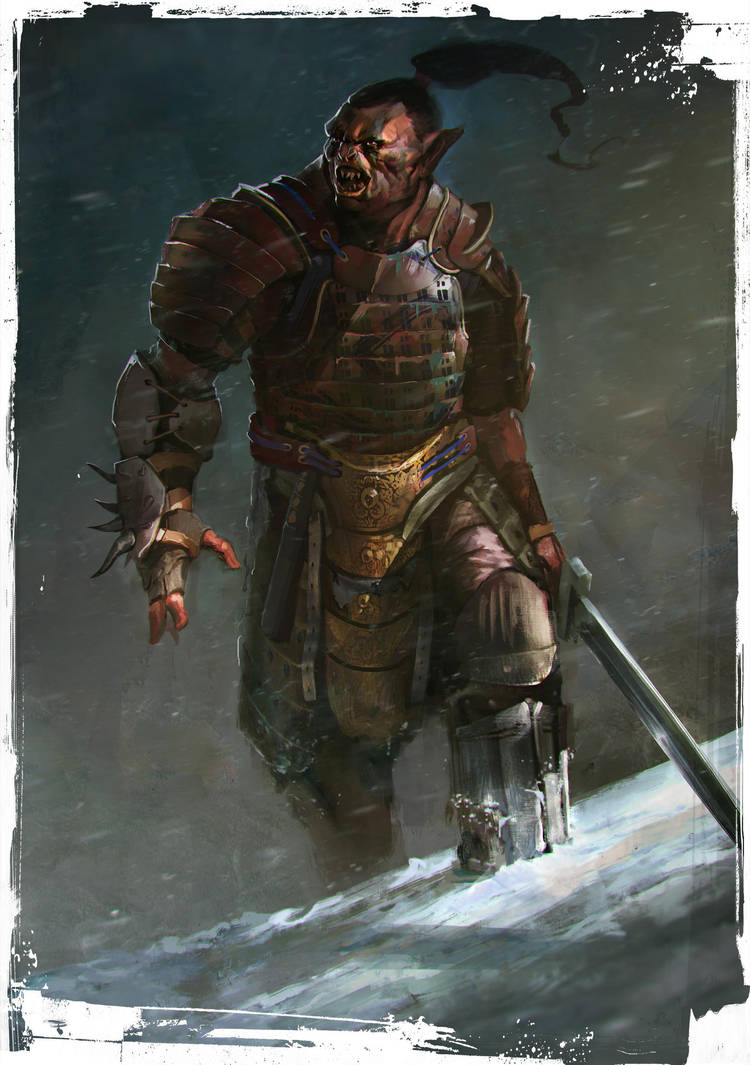
An Alternative Hobgoblin

Art by Alex Tzutzy
Hobgoblins were men once. Warriors. The best of their kind.

They fought against the goblins, slaying them in their hundreds. The goblins watched them slaughter their kin, ambush their homes, outmanoeuvre their armies at every turn. They looked on with fear, rage, and awe.

When they finally managed to capture the humans, they did not slaughter them. They were instead brought before the goblin shamans, paraded through the war camps, stripped and prepared for the ritual.

Crowds parted as the bloodied pelts of the goblins they'd slaughtered were carried through the camp. One by one, they were bound and stitched to the screaming warriors. They would know fear and pain as the ritual started, and be devoid of it when the ritual ended.

When the men opened their eyes at last, they were men no more. Their skins were stained the colour of blood. Their features mangled under a goblinoid visage. They still had their wits, their minds, their military strategy and knowledge of the battlefield. But their allegiance was with the goblins now. It's in their blood, after all.

Just a small post for now, part of a series of me writing up some prompts I've given fellow D&D players on Discord. This one was in response to 'how should I do hobgoblins in my setting?'

Wednesday, November 7, 2018

Firenewts: Fire, Life, and Blood

Firenewts are a people shaped by the innate belief that heat and life are one and the same. Creatures can of course live in low heat, but life- passion, love, goals, emotions- can only truly be felt in the presence of warmth and fire.

They feel pity for other cold-blooded races. For brief moments, they can feel truly alive when basking in the sun. But in truth their hearts are hollow and devoid of heat. Humans, dwarves, and other such creatures fare somewhat better, for they too can carry warmth within them. But the firenewts- born of lava and devoted to the flames- are amongst the most alive of all creatures of flesh.

Firenewt skin is translucent; it is mostly clear with red markings. Their flesh and organs come in hues of orange and red. As they move and twist and flex, their bodies look like liquid fire. This is where the rumour comes from that they and salamanders are one and the same.

Cannot find original source. If you know where it's from, let me know!
Firenewts need heat to spawn. Their tadpoles grow in lava vents, hot springs, and cauldrons. For this reason their intergenerational communities are limited in size. Urban groups find homes in hot houses, spas, and greenhouses. Their broods are tended to in cauldrons over open flames, and their free time is spent in saunas and steam rooms.

Out in the wilderness, they live around volcanoes.

Firenewt Tables

Like this, but with a sword and riding an ostrich
These tables are in relation to an upcoming post on my personal take on firenewts. They can be used separate from that interpretation though provided that you are alright with using firenewts as a society with a history of militaristic politics, slavery, and fire worship.