Showing posts with label homebrew. Show all posts

Monday, September 14, 2020

I Was Interviewed!


Brewmasters is an upcoming podcast series focused on homebrew content and getting to know the people behind the content. As the creator says:

Brewmasters is the series where we sit down with accomplished home brewers from the dungeons and dragons community and signal boost their achievements. We discuss their table top rpg interests, their work, inspirations, methodology, and share advice for everyone interested in making their own homebrew content for D&D.

u/Caelestis was kind enough to sit down with myself and two other moderators on the Discord of Many Things to discuss changes to the server, as well as about our homebrew works and issues within the D&D/WotC community.

I really enjoyed the process, and Caelestris was a wonderful host for us. There's a few bits I bring up that I think should have been worded in a more nuanced/specific manner (sweeping generalisations and all that), but given the situation I'm pretty content with how it came out.

I was also challenged to make a magic item for the podcast, which I've written up here (balance not checked):

Muse's Ichor
potion, very rare

    This iridescent potion looks like liquid starling feathers. Once consumed, the drinker is overwhelmed by a compulsion to create a great work of art. For the next 8 hours you have expertise in all artisan's tools, and go out of your way to create a masterpiece out of whatever materials you have access to.
    At the end of this period, you suffer two levels of exhaustion and must roll a d20: on a roll equal or lower than your level, you succeed in creating a masterpiece. On a failed save, it's still pretty good, but kinda eh in comparison to what it could've been. This doesn't affect the masterpiece mechanically, but it does leave you feeling a little disappointed.
    The masterpiece is not limited by size, shape, form, or physics; it cannot be used as a weapon, nor can it have an intentionally harm-inducing purpose (such as a guillotine or explosive sculpture). Any creature that spends a short rest observing and considering the masterpiece gains a d10 in Bardic Inspiration, which can be used within the next 24 hours. A creature can only benefit from this once per masterpiece.

If you want to listen to the whole thing, click here (YouTube link, will open in external tab/window).

Wednesday, August 5, 2020

Aarakocra: Nope No Longer

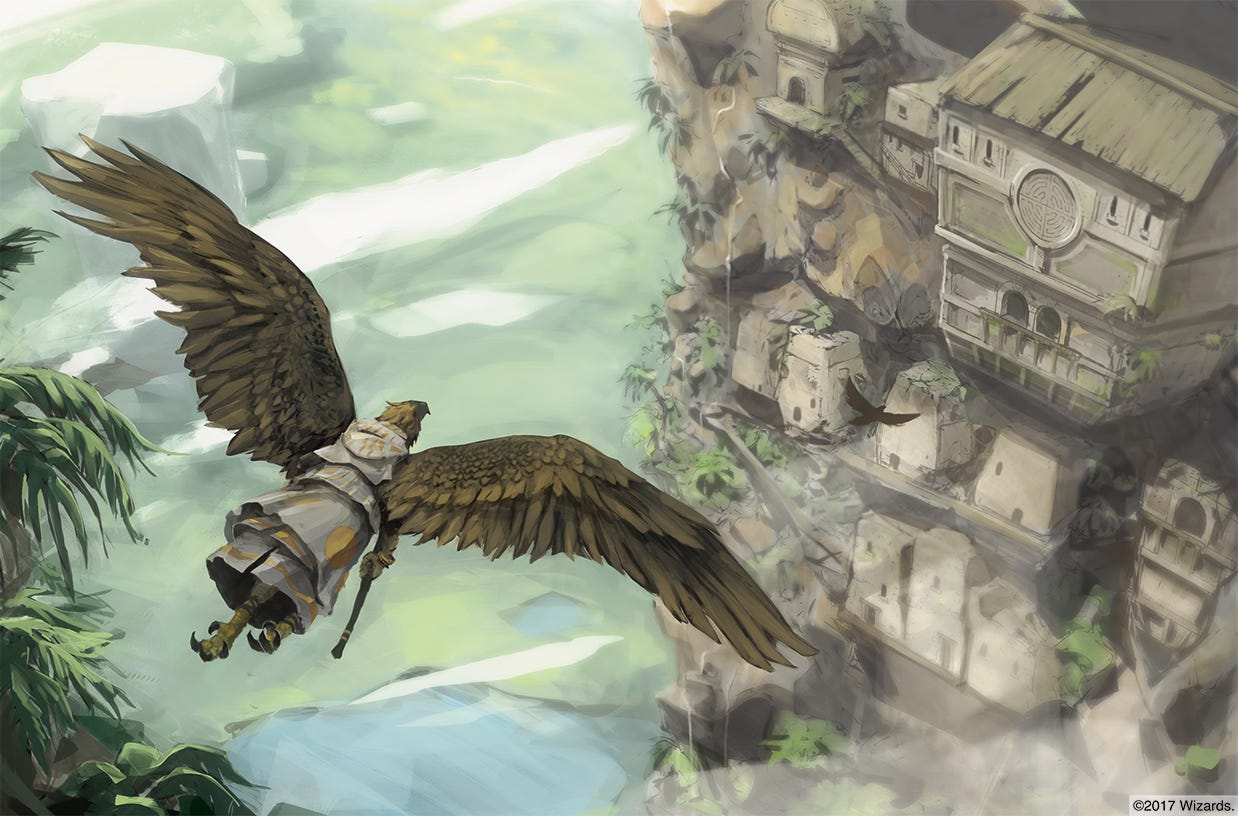
Aarakocra art from Tomb of Annihilation (2017)

this post specifically deals with 5th edition Dungeons and Dragons content.

Bird people are a cool concept. They combine the speed, gracefulness, keen eyesight, and predatory drive of a raptor with thumbs. Wizards of the Coast exploited this niche with the introduction of aarakocra as a player race, added to 5th edition in Princes of the Apocalypse. These hexapodal avians became the first player race in 5e to have an innate flying speed - giving them 50 ft of flight, provided they aren't wearing medium or heavy armour.

Since then they have been systematically banned from almost every D&D table I've sat at and every online game I've taken part in. The same goes for games across the globe, as the notion of a player race that can move vertically instead of horizontally is declared time and time again to be an unwelcome addition to the game. Personally, I think this is a shame, as aarakocra strike me as such an interesting player option that opens up various doors of gameplay and campaign design to both players and the DM. What's worse, the way that some DMs have gone about trying to "correct" this issue for their tables both completely negates player expectations and is arguably a more work-intensive method of getting the result they initially wanted of not having to deal with aarakocra in the first place.

So, before we "fix" these wonderful bird people, let's ask: "Why do DMs not allow aarakocra in their games?" The answers that I see most often roughly fall into two categories: balance and compensation.

Sunday, April 12, 2020

Homebrew: Underwater Mechanics and 3D combat in Roll20 (D&D 5e)

"There is heroism and brute warfare on the ocean floor, unseen by land-dwellers. There are gods and catastrophes."
~ China Mieville, The Scar
That which lies below the waves is an interesting and terrible place indeed. It is also a great location for stories and campaigns, and as such saddens me that I cannot enjoy it more often. One of the primary reasons for this is due to the additional rulings, which are seen as limitations on characters that want to flex their entire skillset. Personally I am of the belief that these rules should not be seen as limitations, but as demonstrations of the pressures on aquatic life, and as a way to explore how these pressures have been overcome or coexisted alongside.

Below are some rulings that can be used by DMs that want to emphasise the effect of being in an aquatic environment on characters and objects. These rules would also be good to consider for subterranean games, as many underground rivers and sea caves and the like exist below the earth.

Core Rules

Official rules related to underwater gameplay can be found in the following areas:
Player's Handbook: breathing underwater/suffocation (pg 183); underwater combat (pg 198)
Dungeonmaster's Guide: extreme cold, frigid water, high altitude aka effects of pressure (pg 110); swimming (pg 116); underwater visibility (pg 117)
Ghosts of Saltmarsh: ocean environs (pg 202-207); currents, depth illumination (pg 203); pressure and objects (pg 204)

In addition, Appendix A of Ghosts of Saltmarsh includes rules on ships and naval combat; Storm King's Thunder also includes a ruling on damage at 3,000 feet below sea level (pg 203).

Sunday, March 22, 2020

Faction Prompt: The Stilyard


The Stilyard deal in luck, morality, and free will.

In return, you incur a debt to be paid. This is not a debt of coin, but a debt of choice. You owe them a moment of your free will.

You won't find them at city markets, nor do they have shops. The Stilyard keeps themselves hard to find, accessible only to those who truly have the drive to seek them out. Those that find them and those they seek out are a special clientele - individuals that live lives filled with harsh decisions, drastic action, and catastrophic failures.

Goals

The Stilyard's true objectives are hard to determine, but there are clues in their transactions. They trade free will for control, luck for finality, chaos for order. The Stilyard wants to see the world on a script, with each line pre-rehearsed and each part played correctly. Whilst it presents itself as a neutral party, it is an inherently Lawful Neutral faction, for the only payment it seeks is the ability to determine how events will play out. What exactly the final end point is is unknown, potentially even to the Stilyard themselves. But there is a degree of comfort in knowing where all the players in life's stage will fall, what their lines will be, and how things will end before the curtains fall.

Individuals that work for the Stilyard can apply to have their own choices and goals taken into consideration when payment is due - the degree of influence they have increases with the amount of dealings they make. In return, their power over decisions can only be used at the authorisation of the faction as a whole.

Cuombajj Witches by Seb McKinnon

Mechanics

Members of the Stilyard can provide two primary forms of service. Firstly, they can alter alignment (if such a mechanic exists in your game). Depending on the system, this may be a percentage/value reduction or a binary change, depending on whether the relevant mechanic is analogue or digital.

Secondly, they can sell luck. Mechanically speaking, they sell a predetermined dice roll to the player, which they can use to replace a roll of their choice, after which it is expended. For D&D 5e, this would allow them to replace an ability check, saving throw, or attack roll. Treat this as if the player is using the divination wizard's Portent ability.

In return, they seek control of a player's luck or free will in the future. For a dice roll, the Stilyard may choose the player to succeed or fail on a dice roll that would directly or indirectly benefit the Stilyard. The DM can either choose such a roll based on the action's consequences, or roll a d20 (or d100) and then determine that, in that number of rolls, the Stilyard makes its move. The roll the Stilyard chooses can either be proportional to the player's dice roll (e.g. a 1 for a 20, a 5 for a 15, a 3 for a 17 etc) or could be rolled immediately after the transaction is made.

For an alignment shift, the Stilyard requires a heavier price to be paid: 1d8 hours of a character's free will. There is no saving throw for this control.

d10
What the Stilyard does with your free will
1 You sign a devil's contract with your own blood
2 You march into a courtroom as a surprise witness
3 You set up an assassination for a passing noble
4 You tell a beloved friend the truth they needed to hear
5 You donate half your carried wealth to a noble cause
6 You deliver a package to someone in a back alley, then drink to forget
7 You allow a spirits to inhabit your body
8 You act as messenger for other Stilyard clients
9 You witness a brutal, unforgivable crime... and walk away.
10 Nothing seems to change from what you would normally do

Inspired by the Mann, Levinn, and Lewis Firm from Wildbow's Pact series.

Sunday, September 8, 2019

Reintroducing Alignment

I wanted to get some vague ideas down on how alignment could be made into a more integral part of 5e, either in general or for a specific setting or campaign. Many of these suggestions are mechanical and come down to the same root point of having alignment be more mechanically present than it is currently, but there are a few lore suggestions here and there as well.

Unfortunately this post is going to be a bit disorganised, though that's nothing new here.

It's also worth mentioning that this isn't a post on why alignment should be implemented, merely how.


To start off, I'm going to give definitions of alignment. The notion of what is or isn't under which alignment is flexible and open to interpretation, but for this post I'm going to steal and tweak my definitions from a previous post I made on alignment-based factions:

Good: acting for the benefit of others, especially when no personal gain is achieved from it. Altruism, compassion, and empathy are tenants of Good.

Evil: allow or enforce suffering upon others, for one's own benefit or for no benefit whatsoever. Selfishness, manipulation, and abuse are tenants of Evil.

Law: adhere to and enforce a set structure to life and society. This could be a city's laws, a factions rules, a deity's oaths etc.

Chaos: promote free will and metamorphosis, opposing control and restriction, and abiding by one's own sense of how to behave.

Alignment for characters has a dominant trait and a recessive trait, as shown with capitalisation. This is used to indicate which of the two alignments - law-chaos and good-evil - overrides the other in decision making. For example, a Lawful good character will choose Law over Good if pushed, whilst a lawful Good character would choose Good over Law.

Unaligned creatures are such because they lack an understanding of the alignment system and as such are unaffected by its influence. Whilst an animal may act in a chaotic neutral manner, it does so because of its instinctual drives, not due to a sense that the alternative is morally wrong or unfavourable. Creatures with completely different senses of morality and alignment are also classified as Unaligned - in my books, this should arguably include oozes and aberrations, given that their minds are so alien to ours that they may not work on the same notions that we do. They are outside of alignment.


A game that brings back alignment as a prominent aspect should bring it to the front mechanically as well as in theme and lore. D&D does do this, but 5th edition does so significantly less than past editions. We mainly see alignment present in these aspects:

Spells: spirit guardians has its damage type vary on character alignment. This kind of thing should be expanded upon. Different character alignments or deity alignments should influence damage types, or potentially further influence spell effects. Perhaps casting burning hands whilst Chaotic in alignment makes more things ignite on contact, or bless and bane could be the same spell, with the effect changing based on whether you're Good or Evil?

Monsters: There are some monsters that have alignment-based abilities. Sprites can detect alignment using their Heart Sight; rakshasas are vulnerable to piercing damage from good-aligned creatures; demiliches and unicorns have lair traits/regional effects that affect non-evil and good creatures respectively. Planar creatures especially show these traits, which is to be expected given their stronger connections to alignment.

Items: Items show some of the more prominent alignment mechanics in the game, with items that can only be attuned to if you are of a specific alignment. This makes sense to include, or potentially to expand upon: perhaps an Evil artifact can be attuned to by a Good person, but the abilities they get are different. Alternatively, maybe their abilities are warped? A Good cleric attunes to the Evil item and now all of her healing spells instead deal necrotic damage, or only give temporary hit points?


As a vague idea, why not have the forces of alignment be more conventional large-scale forces, like deities? We have dichotomous notions of deities in real world religions (e.g. Abrahamic God and Satan), and Forgotten Realms already has the alignments act as planar forces, so why not have gods of Good, Evil, Law, and Chaos? These could in turn create the gods of dual alignments, and/or create emissaries to spread their influence - the devils, slaadi, celestials, modrons etc.

With my personal prefernce for Chaos and Law, I'd potentially go for a god/entity of each of these, which in turn have six opposing spawn (for Chaotic and Lawful good, evil, and neutral).

Alternatively, why not go the route of Avatar? Each alignment is an ideology and way of life, none perfect on their own but best seen in their interactions with one another and the balance of the four. In such a setting, Neutral may be seen as the ideal state to be in, with players traveling the land to learn about the different ways of life and their influences on the world. This could also be an interesting way of exploring how different alignments look from outside perspectives, and how they can come across in many different forms.

An important idea in such a setting to get across for me is that the prescriptive nature of character alignment is something special - it is an indication of free will and the ability to make choices. It is this that differentiates them from celestials and fiends, and this that links them to giants, dragons, and other such creatures. Whilst they may lean towards certain alignments, this isn't set in stone.

This is in contrast with extraplanar entities that directly serve the ideals of their alignment. Their alignment is a fixed state, a constant (yes, even the Chaotic entities) mindset that is unwavering. It can be confused, misled, possibly even manipulated, but their actions and personality are inherently shaped by what they are. Unlike players and other such entities, where alignment is prescriptive, these entities have descriptive alignment.


Alignment Thresholds
Alignment is on a scale for a reason. There are degrees to which an individual shows alignment, and having thresholds is one way that players can quantify how Good or Lawful their character is.

This is akin to Ravnica's Renown rules, where completing certain actions increases your level of influence and benefits within a faction. It could also be compared to the Humanity and Path tables in Vampire, where committing certain acts influences your behaviour and abilities.

The DM would have a table for each alignment. On these tables are actions and modifiers - actions such as harming an innocent, forcing an ally to face the force of justice, starting a rebellion or putting yourself in harm's way to save another. When players commit an action, the DM can alter the number of points they have on the alignment axis. You need a minimum number of points to be classified as an alignment; under this you count as Neutral.

Upon reaching certain point thresholds, different boons become available to you. These range from being more amiable with creatures of the same alignment to actual abilities based on the tenants of your alignment. They should ideally be beneficial to both martial and spellcasting classes, and have some flavour based on your alignment of choice. Perhaps there could be multiple to choose from, depending on how detailed this system was.

EDIT: After some discussion, these boons should ideally be focused on non-combat aspects of the game to prevent players going specific alignments just for certain attacks or combat benefits.

If you drop below your alignment threshold, the boons you had beyond your new score are lost to you.

These boons may also be available to NPCs, giving nice flavourful mechanics to your allies and enemies, and also informing players about what kind of person or creature you're dealing with.

Sunday, July 28, 2019

Selkie Race for D&D 5e

In a similar time frame to making my medusoids, I also made a race block for selkies, a creature from Scottish folklore that is essentially a sensible response to the Mermaid Problem but with seals instead of fish.

The Selkie by Kitty-Grimm

Here's the lore part I included:

The elusive selkies or seal-folk are mostly known of through sea shanties and bard songs; typically the tales of fishermen that steal their pelts and coerce them into marriage. The pelt must be hidden, for as soon as the selkie finds her pelt, she returns to the sea and is never seen again.

Few selkies that choose to interact with the surface world are open about their origin, predominantly due to these tales. Those that are not deterred by these stories tend to come to land to either learn more of the strange world of air and sky, or to seek vengeance for the hunting of one of their kin or the polluting of their homelands.

A selkie without their pelt is near identical to a human, bar some unusual skin blemishes akin to seal spots and the smell of salt on their skin. The children of humans and selkies are less fortunate; they are born with webbed hands and feet, with a rare few born with even more seal-like traits. These individuals may be kept on land by their human parent as a reminder of the love they once had, or rejected and cast out into the cold seas that are no more their home than the harbor towns and fishing villages they were born in.

I've also included a rough statblock for a generic seal, given that there wasn't one already (I mean, there's the sea lion, which could maybe be a form obtained later on as a feat or something?)

To read the racial statblock, check out the link here. The art in the document is Vengeful Selkie by BeaGifted.

Sunday, July 7, 2019

Medusoids: Jellyfish people for D&D 5e

Just a quick post today, sharing a brew for jellyfish people inspired by Caitlin Soliman's art, especially her jellyfish-themed mermaids:

Here are just a few of them!
As a bit of lore for them:

Watchers of the tides and archivists of history, the medusoids measure their lives not in years, but in aspects: units of time defined by going from one life to another. As one aspect withers, it is rejuvenated into an infant state, equipped with knowledge from its past lives and a fresh, new outlook on the future.

Medusoids that answer the call to adventure do so due to a need to change the world they have witnessed for so long, either to restore some constant balance or to instil long-needed change. Though not physically strong, they compensate for this with great knowledge and an array of nematocyst-ridden tendrils emerging from their bodies.

Tales from the surface speak little of the medusoids, other than sailors telling drunken tales of singing jellyfish, ghosts of drowned wives-to-be, and strange findings of translucent clumps of vaguely humanoid flesh washed up on beaches, clean of pecks by any seabirds.

To read the racial statblock, check out the link here.