Showing posts with label needs more work. Show all posts

Wednesday, August 5, 2020

Aarakocra: Nope No Longer

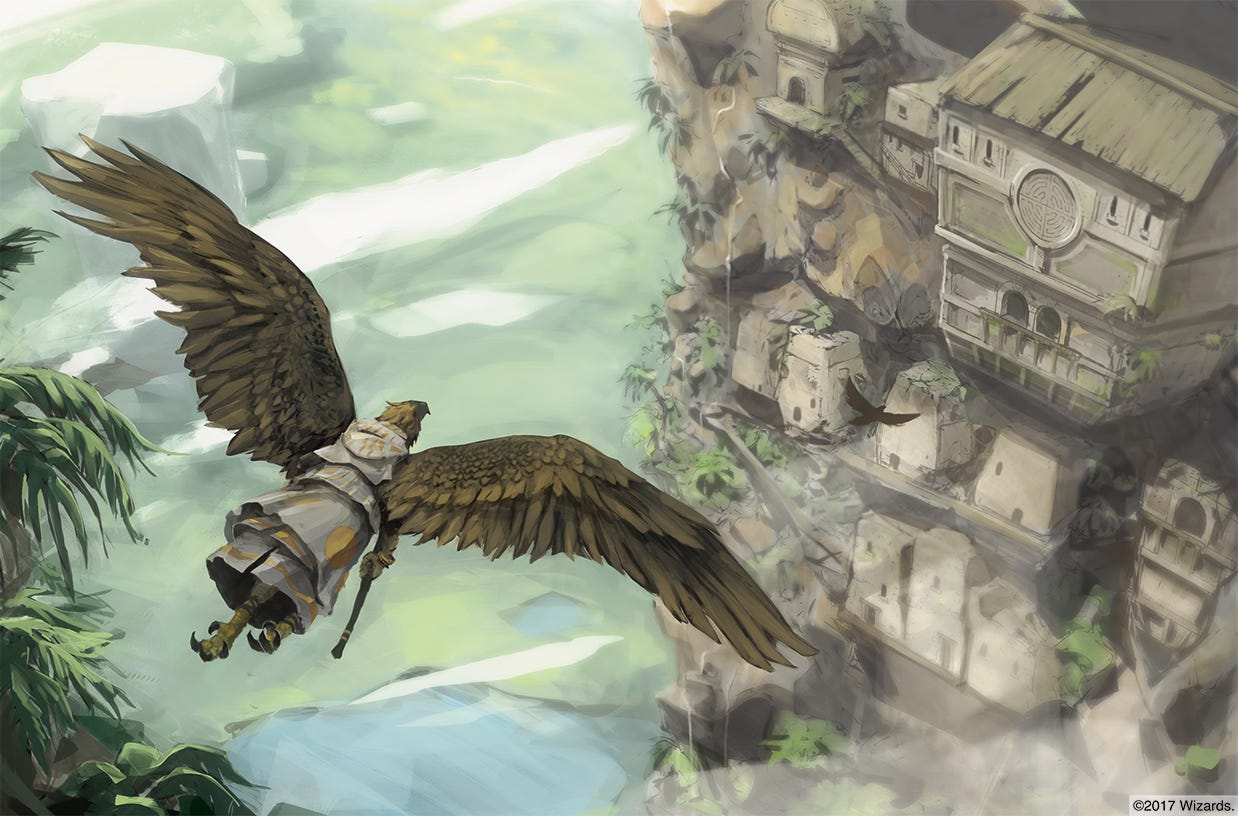
Aarakocra art from Tomb of Annihilation (2017)

this post specifically deals with 5th edition Dungeons and Dragons content.

Bird people are a cool concept. They combine the speed, gracefulness, keen eyesight, and predatory drive of a raptor with thumbs. Wizards of the Coast exploited this niche with the introduction of aarakocra as a player race, added to 5th edition in Princes of the Apocalypse. These hexapodal avians became the first player race in 5e to have an innate flying speed - giving them 50 ft of flight, provided they aren't wearing medium or heavy armour.

Since then they have been systematically banned from almost every D&D table I've sat at and every online game I've taken part in. The same goes for games across the globe, as the notion of a player race that can move vertically instead of horizontally is declared time and time again to be an unwelcome addition to the game. Personally, I think this is a shame, as aarakocra strike me as such an interesting player option that opens up various doors of gameplay and campaign design to both players and the DM. What's worse, the way that some DMs have gone about trying to "correct" this issue for their tables both completely negates player expectations and is arguably a more work-intensive method of getting the result they initially wanted of not having to deal with aarakocra in the first place.

So, before we "fix" these wonderful bird people, let's ask: "Why do DMs not allow aarakocra in their games?" The answers that I see most often roughly fall into two categories: balance and compensation.

Friday, July 31, 2020

Player-led Game Conceptualisation

Not really a post-proper, more of a writeup of some stuff I've been thinking about over the past few days as I go through GM withdrawal. It is by no means meant to be a gripping read.

I think some of my favourite games to plan have been the ones where the players suggested the base premise. The players-to-be sat in a group, eating snacks and talking about what would be cool to play. In one instance, the group said they wanted to be somewhere non-temperate and fight a classical D&D villain of high level. Tomb of Annihilation was just about to launch, and from it the Jungle-infested island of Sebek was born, under threat from a slaad-growing lich. In another instance, the group had seen a comic premise for a prince & his allies seeking to reclaim the throne. From this we created the starting blocks of a realm-spanning political campaign, as the group designated one player to be the prince they rallied behind as they went to gather unlikely allies and reclaim the throne from a mysterious usurper.

The reasoning for this is obvious. It immediately creates player investment: this is what they think will be fun. Much can be gained from players having characters they are invested in, but starting off with a story that they want to see through, or themes they want to explore, or a setting that comes from a shared moment of creativity can also work wonders.

It builds hype as we discuss the idea: spoilers are out the window as the game isn't made, we're just throwing ideas around of what would work and what wouldn't. It keeps me on my toes and gives me an opportunity to try something new. I would not voluntarily choose to create a campaign about succession and the merits of monarchy, but it was super fun to explore the idea and make it into something; it was even better to see the ideas the players came up with and weave them into the story.

There are of course limits. In both of these cases, the ideas just clicked with everyone in the group, but this won't always be the case. Perhaps if this was going to be refined into a more organised system – a player led Session Zero perhaps? – then some guidelines would need to be placed, both in terms of majority preference and what the DM is not interested in running.

I should try and do this more often.

Monday, June 24, 2019

Game of Mold: Assorted Notions

I found this video a while back. It's pretty neat.


It inspired me to try and make some kind of politically-charged fungal setting, but I haven't yet honed it down to its key components or what the general notion of the setting is. I still got some ideas down that I feel like sharing though.

This is a world of decay, where fungal houses fight over territory and power. Politics is dealt through spores, mycelium, and control of organic matter. The setting's land is heavy in themes of decomposition and rebirth. The living die and are reborn once more in new bodies, ready to feast upon the dead and die once more.

Through the Southern Gate by Cze Peku
The noble Houses are fungi. Their territory and their physical selves are one and the same, making them all very dedicated to their cause. Each has its own names (never only one), desires, smells and preferred substrate.

The houses have always struggled for power, and have been doing so since the First Flesh died. The world is built on layers and layers of composting political parties and failed rallies.


Cordyceps by Jacob Dunkan
Titans of past civilisations and worlds still stand, slowly encroached with lichens and fungus.

Fruiting bodies spread their spores throughout the land, creating an ever-constant mist. Vague whispers of slogans - "ours is the cure", "death is not the end", "untied we rot" - drift through the clouds, subtly influencing the behaviour of humanoids and beasts alike.

On the Shore of Dreams by Cze Peku
The Dreaming. The collective world of ancestral subconscious; hallucinations of the dead and dying, live and living. Sometimes spores and creatures lose themselves here, becoming more sensory entity than physical. These creatures are abstract forces of synesthesic being, and they have escaped decay by exposing themselves to mental decay. As long as they are sensed, they exist.

Mushrooms by Anastasia Wyatt
There are living beings here. The next generation of fertiliser, or the descendants of detrivores and fungivores. Ghouls, flyfolk, gnolls, and other such beings have been and gone. The fungus enters their bodies at a young age, grooming them into political weapons and tainting their bodies. Some have the gift to turn these infestations into weapons of their own, combining hedgemagic, basal druidry, and diplomacy.


Mushroom soldier by Maxim Verehin

The living that lose themselves to the infection become walking envoys of the houses. Visually similar to myconids but equipped with speech and eyes for a while. These envoys are invaluable to the houses - they provide a rare glimpse into the minds of their voters, allowing them to see where their allegiances lie. The minds of humanoids are as alien to them as a fungal mind is to us.

Meat by Maxim Verehin
A pastor of the Exquisite Corpse. His life and entrails are laid out before him, all the better for him to predict future omens and aid in medical research. Surely their power must be great, for none of their open wounds become septic- those that do are, of course, not truly faithful.

High Priests take offerings from their flocks of the sick and dying. These offerings of functioning organs are integrated into their own, allowing the priests to better love their charges.

The Exquisite Corpse is a faith of purity and fullness in one's actions. They teach that one must act with full intent of their actions, and that doing so will help them distill their essence and allow their bodies to reject external entities.
Assassin's Trophy by Seb McKinnon

The casualties of war between the houses are many. Fortunately, this one cannot speak of the atrocities it has seen.

Societies rise and fall throughout the layers of rot, and dedicated excavators can earn a living by trudging through the grime and bringing back relics that haven't decayed. The way is harried by giant worms, fungal abominations, oozes, and hidden guardians.

Parasitized Moth Warrior by Vasco Mariano

A fungal inquisitor infects and interrogates a dustknight. Their methods are curt and its questioning equally so. For some, infestation and decomposing before one's own eyes is enough to make one betray their house. For others, the inevitability of death makes their threats worth little.

Arachnid Knight by Chenthooran Nambiarooran
Mannimarco, The King of Worms by Shamine King
Left: a dustknight, plated in chitin and wielding large blades. Their oaths are made to preserve the memory of the living, to stop people straying too far into the Dreaming, and to fight against the final decomposition: the time at which there is nothing left to grow upon, and the final fungal bodies break each other down into dust.
Right: undeath is one of the ways to escape fungal enslavement. Mushrooms grow on dead things, and those that remove decomposition from the cycle are free from their influence. As such, the study of necromancy is rich, with liches wandering market streets alongside worms that walk.

decay by Vladislav Orlowski
Speakers of the Chytrid. An ancient household, noted for the slaying of many of the great Olms that hide in dead lands.

universal carcinogen scp - 135 by Vladislav Orlowski
A prophet's birth is rare indeed, and many lords hope for their death to bring about the coffin birth of the realm's next saviour.

Thursday, March 14, 2019

Faction Prompt: the Dreambreakers

A bit of a shorter post today- just want to get ideas down onto a page so I can work on them later when I have more mental energy.

Beholder dreams warp reality. To dream of another beholder creates more beholders; to dream of blood loss creates a death kiss. Many have speculated as to where beholders go in their slumber, by what power they can bring new life into reality, and whether this power is solely limited to a beholder-like manifestation.

Enter the Dreambreakers*.

Mages and psychics. All working to decode the psyche of beholders, to access their dreams and probe them in the desired direction.

Their large scale methodology is simulations. Sometimes simulations within simulations. Interacting with the beholder's subconscious, interpreting the characters and setting to gain further insight and access. There they travel as shades of their past selves, warped by the beholder's madness and subconscious influence.

The Dreambreakers of course must have beholders to indulge their research, and precautions against their physical forms being destroyed by whatever entities the beholder dreams up. Some choose to infiltrate beholder cults and organisations, acting as servants to get close to their aberrant masters. Others hire adventurers to incapacitate beholderkin, or to find weakened and diseased individuals that can be easier to exploit.

Conflicts are frequent. Different people interpreting dream aspects often results in mixed views. This conflict and tension ripples through into the dreams, which in turn shape the dream itself. Little is truly hidden within the dreams of the beholder.

As the members enter the dreams, they too may be dreamt into existence. These copies are mostly the same. They hate their originals, and will seek their immediate destruction. The Dreambreakers are aware of this- they all have their own copies to hide from, small gangs of not-entirely-themselves that seek their deaths. They also have experience encountering (but not stopping) the other entities their experiments bring into the physical world.

*Dreambreaker is a sucky name and I need to come up with a better one if I ever intend to use this in an actual game presented to players I respect.

Sunday, February 24, 2019

Heads of Lerna

Based on some brainstorming for a cult dedicated to the Lernaean Hydra.

Awakened Hydra by Artur Treffner
The Heads of Lerna are cultists that treat the hydra as their totem and idol. They provide her with protection (from her perspective, they provide a distraction for those wanting to disturb her slumber), food, and treasure, and in return the hydra provides the tools for the cult's machinations: her poison.

The toxins of the hydra emanate from everything: blood, tears, saliva, breath, shit. All of it is toxic, most of it is lethal. The cultists have gained resistance over time to the noxious fumes she produces, but her blood is still dangerous. Most of the toxins they take from her come through saliva and waste products, or collecting the water that she wallows in.