 |
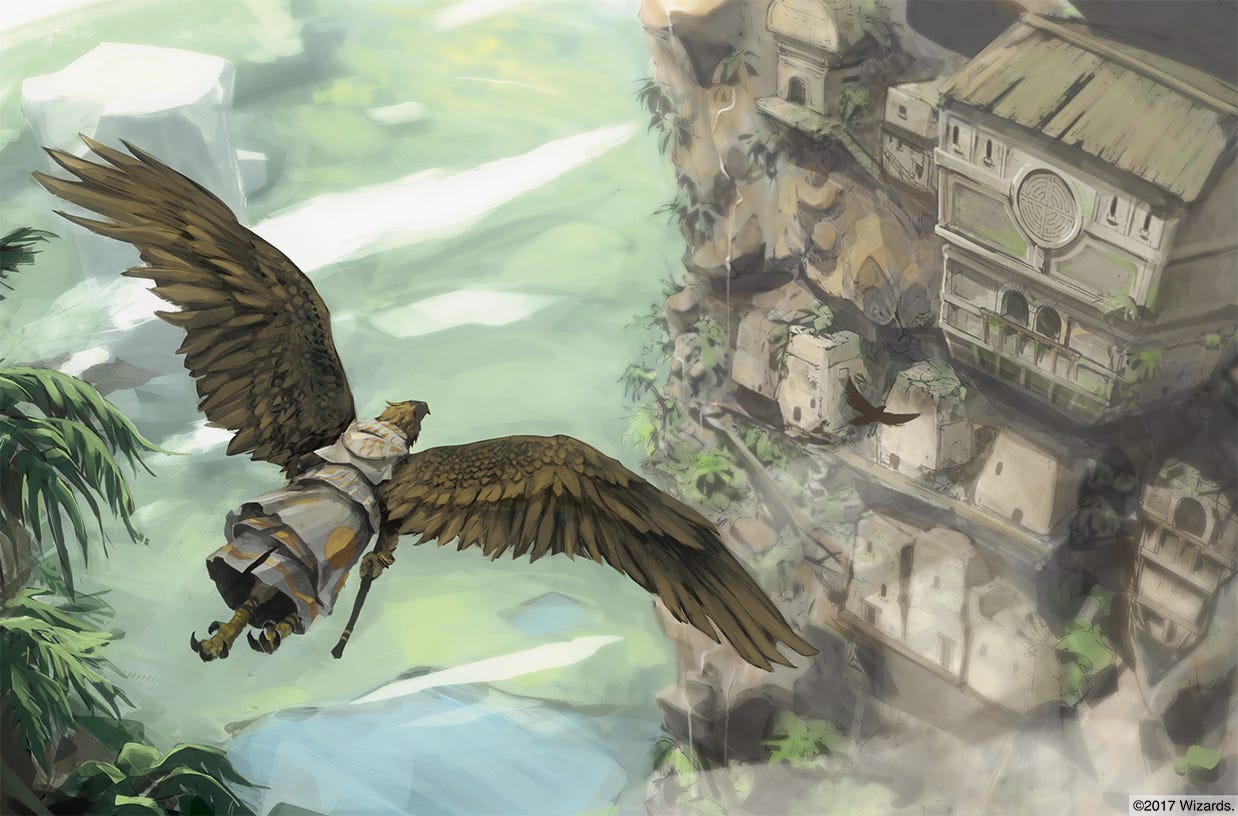
| Aarakocra art from Tomb of Annihilation (2017) |
this post specifically deals with 5th edition Dungeons and Dragons content.
Bird people are a cool concept. They combine the speed, gracefulness, keen eyesight, and predatory drive of a raptor with thumbs. Wizards of the Coast exploited this niche with the introduction of aarakocra as a player race, added to 5th edition in Princes of the Apocalypse. These hexapodal avians became the first player race in 5e to have an innate flying speed - giving them 50 ft of flight, provided they aren't wearing medium or heavy armour.
Since then they have been systematically banned from almost every D&D table I've sat at and every online game I've taken part in. The same goes for games across the globe, as the notion of a player race that can move vertically instead of horizontally is declared time and time again to be an unwelcome addition to the game. Personally, I think this is a shame, as aarakocra strike me as such an interesting player option that opens up various doors of gameplay and campaign design to both players and the DM. What's worse, the way that some DMs have gone about trying to "correct" this issue for their tables both completely negates player expectations and is arguably a more work-intensive method of getting the result they initially wanted of not having to deal with aarakocra in the first place.
So, before we "fix" these wonderful bird people, let's ask: "Why do DMs not allow aarakocra in their games?" The answers that I see most often roughly fall into two categories: balance and compensation.
Balance
For the most part, it is argued that a player race having an inherent flying speed is imbalanced. As reference, here are several of the other methods a PC can get a flying speed without having magic items:
- The protector aasimar subrace, which gains 1 minute of flight as an action, once per long rest, at 3rd level
- Spells, the earliest of which being fly, requiring a PC to be 5th level to expend 3rd level spell slots
- Druids can wildshape into a flying beast at 8th level, for a duration equal to half their druid level
- Barbarians of the totem subclass that take the eagle totem at 14th level gain flight until the end of their turn when raging (rage lasting for 1 minute, or until you're unconscious at 15th level)
- Draconic and divine soul sorcerers both get a flying speed at will or until dismissed at 14th level
- Tempest clerics can get a flying speed when not underground or indoors at 17th level
- Storm sorcerers can gain an innate flying speed at 18th level
- Vengeance paladins can gain flight for 1 hour at 20th level as part of their Avenging Angel ability, which is available once per long rest
The argument goes that, because the majority of ways to get a flying speed require a player to be of high level, innate flight should be reserved for those levels; below this it should be a temporary occurrence or it is imbalanced/OP.
This is, however, a subjective stance. WotC has made it very clear, both directly and indirectly, that being perfectly balanced is not a core goal of their game. In addition, many of the ways that the D&D community (and its splinter communities) define and categorise balance are also subjective in nature, based on the consensus of the community to determine values of complexity/power for racial traits.
Compensation
By compensation, I am referring to the need for DMs to put in extra work to accommodate an aarakocra. This is based on the notion that a DM can plan out a campaign, only to find aspects of it easily overcome or ignored because one player has early access to a flying speed. This especially applies to combat, where an aarakocra can make use of their distance and fast speed to keep out of range of enemy attacks whilst launching ranged attacks of their own. Outside of combat, there are also concerns to be had with players deciding to fly off and away from the narrative, or traversing up the ancient wizard's tower or the cragged mountains of doom in order to skip all the filler content and get straight to the boss fights and loot, leaving the rest of the group behind in the dirt.
Yes it provides extra work for the DM, but let's be honest, D&D is a game where the DM has a disproportionate amount of work anyway. Accounting for flight is not a massive issue in comparison to dealing with, say, any spellcaster and the magic they can pull out of their sleeves.
If you are in a game where aarakocra are present in the world, as well as anything else with a flying speed, it is reasonable to assume that people have methods for dealing with winged threats. Examples include ceilings, or archers (your aarakocra is likely an unprotected lone target in the sky), or magic.
Note that whilst I believe these points have issues, I have not outright said either of them are bad or wrong. I think people take them as gospel, and I think new DMs that come into the game and find this to be the main response to the aarakocra race are likely to follow suit without much questioning of it, but I think that if you genuinely believe that a flying race is going to ruin your gameplay and the fun at your table, then that's fine. This mindset is not what led me to write this article.
What did cause me to write this is the presence of DMs who will allow aarakocra in their games, but only after making them deviate so much from the core appeal that they are no longer enjoyable to play. Examples of this include:
- Significantly limiting the duration that aarakocra can fly
- Making players agree not to use their flying speed until told to do so
- Having aarakocra players start out with broken wings, which miraculously only heal when the PC is at a level the DM is comfortable with
- I've heard of at least one case where a DM had their aarakocra PC get their wings torn off in their first combat encounter, just so the aarakocra couldn't fly and 'ruin their game'
This frustrates me immensely. You are removing the core mechanical element of the race that players want to interact with: flight. This is especially so in cases where DMs render that trait null and void or remove the character's capacity to use it, such as in the wing-tearing example. What you are essentially doing in this scenario is informing your players that you do not want their character at the table; that their character is OP, or a pain to account for, or just mechanically not viable in your game, and that you would rather hinder their character than be upfront and say no to their presence. It's like cutting the hands off a wizard, or having a triton only able to breathe water for 1 minute per day: it renders the point moot and dampens the fun of the player in return for a sense of balance and normalcy for the DM.
With the above in mind, here are my personal recommendations of options for DMs as they decide whether the aarakocra race should be allowed at their table.
Option 1: Remove Aarakocra From Your Game
If you limit the flight potential of this race, it is my opinion that you are letting down the expectations of your players. It is better off to not have them as a player option than to limit them so much that they are not worth playing.
For some DMs, including a race that has innate flying is going to be problematic, either because it is something they do not want to deal with or it is something that will encourage their players to express behaviour that the DM doesn't care for. That is fine, and it is ok to feel that way and to act on it. By removing them entirely, you are not ruining the expectations of your players, nor are you putting yourself in a position where you will be internally arguing over how you're going to deal with this PC.
Option 2: Allow Aarakocra, Adapt to the Circumstance
Aarakocra can work in campaigns as written. They do of course require a DM to adapt to the new ways that the group can interact with their environment, but this is no different to many of the other ways DMs must strive to challenge and reward their players for their character choices.
As previously written, there are plenty of ways to work with and challenge a flying PC without needing to make special effort to ensure they will be challenged. Many of these are present in the core books, such as nets, longbows, flying monsters, ambushes, narrow spaces - all elements that can be interacted with by the whole party, not just isolating your one winged PC.
Of course this is not always the case, and sometimes challenges will be made easier by a pair of wings. A key to a treasure hoard placed on a high pillar is no longer much of an issue in and of itself, but these are scenarios where you can decide whether such an issue needs extra difficulty added, or whether it's just part of the story that has a simpler solution to other aspects.
Option 3: Give Flight a Cost (that doesn't make the race unenjoyable to play)
The difference here is that these traits are not limiting the potential of players to fly: I'm not giving them a time limit or figuratively clipping their wings, nor am I artificially stalling their race's physiological capacity for flight.
I've seen some people suggest something like hollow bones (vulnerability to bludgeoning damage and/or reduced AC), which is a potential option but not one I'm keen on putting in the way of my players. Here are two options I came up with, based on the way that appendages interact with one another in the air.
Flight. You have a flying speed of 50 feet. To use this speed, you can’t be wearing medium or heavy armour.
Your hands are part of your wings, and as such when flying your cannot use your hands to make attacks, interact with objects, or use your hands as somatic components for spellcasting. Your feet may be used for unarmed weapon attacks, and benefit from your Talons trait.
Flight. You have a flying speed of 50 feet. To use this speed, you can't be wearing medium or heavy armour.
Whilst flying, you can only make weapon attacks with weapons that lack the Heavy property, and can only make ranged weapon attacks with weapons that have the Thrown property.
The first example works with the idea of aarakocra arms and wings being fused into one appendage (like a pterosaur, not like Donald Duck). Encounters for the PC now become a balance between improved movement and being able to act as an effective combatant; I could envisage similar tactics being used to those of a druid wildshaping as a bird.
The second example keeps the standard hexapodal form, but takes into account the muscle interaction between two large, moving wings and your shoulder blades. I had one person suggest that ranged weapons that aren't thrown (e.g. bows) could be used at disadvantage; I would also allow this.
An additional option on top of this (let's call it Option 3.5) is to change Aarakocra from a Medium size race to Small size. This would reduce their ability to use Heavy weapons (as with my second homebrew option), and they additionally would not benefit from another primary benefit of being Small: access to flying Medium mounts.
This post was inspired by the following Web DM video, as well as various online conversations and discussions about the race in general. The post is also in homage to that one player who really wanted to be an aarakocra ranger in an interplanar game, but we didn't get time to play and that really sucks.

No comments:
Post a Comment