Wednesday, December 18, 2019

Arcane, Divine, Psionic

Magic in 5e D&D is divided into arcane and divine, with psionic being the figurative cousin twice-removed. I discussed this with two of my friends on the Discord of Many Things – ImFromNASA and tiredmoieties – and this is a rough take on the ideas we came up with for how scholars within a D&D world may interpret these three studies.

Magic is, at its most fundamental level, is the distortion of the natural state of things - the warping of reality. Traditionally we distinguish mages by where they take magic from: for example, druids take magic from the latent power of the natural world, whilst sorcerers are themselves producers of magical distortion.

The methods by which individuals seek to create distortion can also be categorised. These refer not to schools of magic, but instead schools of philosophy and ideology: states of viewing the world through which magic is magnified. The effect is similar to that of light refracted by different shaped lenses; the light – magic – is the same force, but the lens – an individual's philosophy – shapes how the magic emerges on the other side.

Premonitions of Chaos by Davide Ottoveggio
The most common of these mental states is that of Arcane magic. Arcanists view magic through the lens of trying to understand magic itself: breaking down the world into its fundamental components and learning how to reorder and reshape them. Spells, rituals, and incantations are all attempts at recalling the equations of creation. It is a form of magic that requires intense research and understanding of multiple fields of knowledge (unless of course you're a sorcerer who simply has an innate understanding of the way they may interact with the world, or a warlock who has such knowledge directly implanted into their minds).

Divine magic views magic through the lens of belief and faith. The individual views the world through a set of ideals and values, as well as through the pre-conceived notions of what their focus of faith (be it god, patron, ideal, or idol) is capable of. The individual then evokes this power, using their belief as the focus of magic. It is due to the nature of belief that clerics and the like can dip in and out of arcane power; as their faith wavers or is tempted, so too does their power. This also goes on to explain why different deity worship evokes different powers: the idea of what magic should do within a cleric's faith is just as influential as what magic theoretically can do.

Finally, there is the most elusive of magics: psionics. For many it is not considered true magic, due to the lack of material components or rituals. However, this is not due to the absence of magic, but instead due to how psionics is channeled. The Invisible Art is the inverse of Arcane magic: instead of focusing on known truths about the world, psionics focuses on the known truths of the self. It delves into one's own mind and notions of the world, using magic to then shape reality to fill in the gaps where reality doesn't quite match up. A psion's power is drawn from the understanding of the self and the self of others, allowing them to connect to the minds of others and free themselves from illusions designed to cloud the truths of their own senses from them.


Friday, November 15, 2019

Making My Own New Crobuzon

I saw that this post by The Githyanki Diaspora has come up to the surface, and thought I'd give it a go as a way to ease myself back into blog posting (been very busy this past month, hence the drop in activity and relatively low quality of this post).

The concept is straightforward: take three monstrous humanoids and three monstrous monsters. These are the residents of your New Crobuzon (based on the city within China Mieville's Bas Lag trilogy). I've decided to go with monsters found in 5th edition D&D to the surprise of none.

Styx by Circle Art

The City

A canal city, founded across a Stygian archipelago. The dead wash upon their shores and float through their canals, providing nutrients and income. Those that aren't quite dead bring with them a willingness to do anything to survive - a willingness that is fully exploited and is an essential part of the city's biome.

The city is simply known as 'the city' to many. The Styx's influence on the memory is strong, and trying to place a name on things is harder still when every bit of water within the city is tainted with the Styx's influence. Over time, all residents lose themselves, becoming a caricature of who they once were and an archetypal resident.

The Residents

Myconids: Decomposers of the bodies that wash up within the city; their mycelium stretch out across the canals and bridges. Many myconids escape within the shared spore-driven dream, clinging onto their shared memories to maintain a state of remembrance and cultural identity. Their physical forms meanwhile remain docile and drugged, used as labourers, messengers, and ferrymen.

Sprites: Sprites are the keepers of law and authority within the city. The city's law is not that of the book, but of the heart, for they can see the true colours of those they touch. They make their homes in the slumbering myconid sovereigns, where they cast judgemental looks at the fiends that they share the city with.

Succubi/Incubi: Where there are souls willing to give themselves willingly to anyone able to give them even the briefest respite from the end, there are fiends ready to be of service. Whilst this was the original reason for their settlement, succubi have grown to enjoy the lack of attention they get here; there are few unwanted lustful looks to be had from mushrooms. Their natural aptitude for charisma leads incubi and succubi to take roles in diplomacy and bartering, whilst their superior ability to defend themselves over myconids and sprites also lends many of them to take security roles.

Crokek'toeck from Baldur's Gate - Descent into Avernus

The Outsiders

Crokek'toeck: This lumbering beast is a mascot of sorts to the city, acting as transport between the city's main islands. It is unaffected by the influence of the Styx, and many theorise that, if it were only smarter, it would be an invaluable resource of information on the city's history and residents.

Intellect Devourers: A customary assassination involves providing the target with an elaborate chest, within which is an intellect devourer that has been chosen to start a new life in the city, taking the victim's place and aiming to amend or avoid the mistakes they made. Many parasitise Crokek'toeck or lurk in the undercity, waiting to ambush unsuspecting victims.

Ixitxachitl: Below the waters of the Styx, the ray-like ixitxachitl act as the city's criminal underworld. For an extortionate price, they'll help those that fall into the waters; for an even higher one, they'll give them back to their families after holding the victim for ransom and taking glee in watching their memories and minds deteriorate.

Sources:

Crokek'toeck - Baldur's Gate – Descent into Avernus, pg 230
Intellect devourer - Monster Manual, pg 191
Ixitxachitl - Out of the Abyss, pg 225-226
Myconid - Monster Manual, pg 230-232
Sprite - Monster Manual, pg 283
Succubus/Incubus - Monster Manual, pg 284-285

Saturday, October 5, 2019

What's in a Name?: a Response to UA Onomancy Wizard

Fear Names.
Names have power in identity.
Others can use names as weapons.
Names are a hook that can be used to track you...
Remain nameless, and you shall be safe.
~ Planescape: Torment

Multiple D&D subclasses inform the DM about aspects of their world. A cleric's domain informs what deities or forces are present in the world, as does a warlock's patronage. The presence of glamour bards informs one of the many roles of fey in the world, and draconic ancestry sorcerers inform the potential for bloodlines of humanoids and dragons to intertwine.

This list has been further added to with the most recent UA's addition of the School of Onomancy, a wizard subclass that focuses on the role and control of true names. Their flavour text states:
Something that is named stands out in the multiverse, distinct from the tapestry of creation all around it. That distinction creates power that onomancers seek to tap.
True names - the concept that knowing an individual's name gives you power over them - are found throughout fiction. From the fairytale of Rumpelstiltskin to the multiple applications of true names in White Wolf's World of Darkness games, to the banishment of DC Comics's Mr Mxyzptlk, the power of names comes in many forms and with many depictions. Dungeons and Dragons has used it multiple times in the past, but this has declined since 3rd edition. In 5th edition published content, the arcane usage of true names is mostly limited to flavour text; the most it can be seen mechanically is with devil summoning:
A mortal who learns a devil's true name can use powerful summoning magic to call the devil from the Nine Hells and bind it into service (MM, pg 67)
On each of your turns, you can try to issue a verbal command to the devil (no action required by you). It obeys the command if the likely outcome is in accordance with its desires, especially if the result would draw you toward evil. Otherwise, you must make a Charisma (Deception, Intimidation, or Persuasion) check contested by its Wisdom (Insight) check. You make the check with advantage if you say the devil’s true name. (Infernal calling spell)
Personally, I love the idea of true names. It's an evocative concept that has made its way into multiple forms of fiction, and creates great opportunities for interesting adventures and roleplay. If players want to defeat a powerful enemy, they can go out of their way to seek the villain's true name, learning about their history and the choices they made to get to where they are, then use this knowledge to compel the villain to surrender or change their ways. It also flows in well with the general idea that words and magic are intermingled, as with bards and their songs, paladins and the oaths they swear, and the words of power within the D&D spell list.

I fully support the presence of true names in D&D, and that's why I cannot say I'm the biggest fan of the onomancy wizard.

Sunday, September 22, 2019

How a Dwarf is Made

Updated on 24/09/2019 to add more depth. Thank you to my readers for getting me to do more with this; I appreciate it when people show interest in my ideas, and when they're willing to tell me that these ideas need to be worked on.

Dwarves are not born; they're made. When a dwarf wants to make a child, they collect materials and begin their project. For some it takes months, others years to get their child together. Some dwarves find themselves overcome by a desire to construct new life - a moment of flash brilliance, akin to a eureka moment. Whilst this may be directed into other constructive pursuits, the potential to make children is always there.

The materials shape the dwarf, but the exact specifics of how are unknown. A mixture of geology and physiognomy is sought to inform the parents of what is best used for their child. The most common material is clay; easy to work with and mold, good for creating a sense of character. Others may be made of soapstone or alabaster. Dwarves with a marble birth are seen in many cultures as being of higher stock, as marble cannot be reworked once carved, meaning they were made with skilled hands and a great deal of preparation.

With no bloodlines to speak of, families and clans are defined by what materials they were made from, where those materials were collected from, and who brought them into the living world. Family relations and proximity can be defined by impurities in the building materials. Whilst an adult dwarf is for all intents and purposes made of flesh, elements of their rock-form still remain in their appearance. Parents are defined by those that crafted their body and whispered the words of life to them. This means a dwarf could have only one parent, or could have half a dozen.

Each child is unique, each one perfect and flawed in its own ways. Baby dwarves look more like golems than adults; as they age they come to resemble living things more and more. During their development they are malleable, both in mind and in body. Strict parents may threaten their children with being returned to the kiln for further work.

When they are created, they are traditionally given time to set, both physically and spiritually. This is time for the earth to find them and know their presence, and for the spirit of the child to find its way into its new body. Once this time comes to an end, the parent(s) hold their child close, whisper their name to them, and give them life.

Of course, time has taken its toll and changed the ways children come into being. Midwives can be commissioned to sculpt a child on one's behalf, or to at least take a more prominent role in smoothing out features and cleaning up the model before life is given. Households may hire the same sculptor time and time again, each with their own signature style of craftsmanship. The discovery of golemancy and the making of constructs has caused cracks in dwarven culture, with some seeing them as a human would see a newly-discovered primate, whilst others see them with the same sense of looming fear as modern man sees a robot/A.I. takeover.

Industrial creation is always an option, though many would claim the children made in the same casts and forges lack the same depth of character, the same intricacies of personhood. There is little to make them unique, no caring touch of a parent, no nurturing loved one to hold their cold body close and bring them into the waking world. In some communities, bringing new dwarves into being is overseen by a committee to ensure the construction is reasonable and follows the community's values.

In rare cases, dwarves may seek to create child clones of themselves. Whilst this is possible - reports do speak of entire clone colonies made to explore new caverns and set up duplicate settlements - the process of creation does not absolutely determine the individual's personality, only their external form.

Myths speak of the dwarves being crafted into being, then being taught how to make more of their own kind. Many more tales of old speak of heroes made from polished marble, tragic heroes covered in deep crack-like scars, and the construction of sentient prosthetic limbs crafted after losing limbs in battle.

Thursday, September 19, 2019

Consider the Sahuagin

Deciding how I want to do sahuagin - or shark-people in general for non-D&D settings - has been difficult, mostly because I haven't wanted to categorise them as inherently 'evil', but at the same time want to evoke the feelings of the official sahuagin and address the elements one would expect from a society of mutant hexapodal shark-men. Here's where I'm up to so far.

character concept by Giorgio Baroni
Sahuagin are predators at heart, and are fully aware of it. They haven't succumbed to bestial fury, but have instead built a culture around their instincts to hunt.

Their connection to sharks is one akin to man's first relations with wolves; not full domestication, but not outright hostility. There is a mutual recognition of kinship and respect, and the sharkfolk have over time developed the ability to manipulate sharks and their relatives to aid them in their hunts, or shoal in designated waters.

Different sharks are chosen for different purposes and regions. Tiger and lemon sharks aid in pack hunting; many a diver has been caught off guard by how tactical a sahuagin hunting pack can be. Hammerhead groups of ~100 individuals guard treasure and lairs, whilst white sharks are bargained with by leaders as guards and enforcers. A few tales speak of gargantuan, ancient sharks being called allies of the sahuagin, with the beasts coming and going for decades at a time, depending on what suits their fancy.

Sunday, September 15, 2019

Tolkien's Dragon-Spell

The Glance of Glaurung by Alexey Rudikov
In Middle Earth, dragons have an ability known as the dragon-spell. This is essentially described as a kind of hypnotic voice/gaze, allowing them to manipulate humans and elves to their will. Dragon-spell could create feelings of distrust, influence the target's perception of the truth (as with Smaug), and even lead to total memory loss and madness (as with Glaurung).

This ability has been connected to dragon-sickness, in which individuals exposed to a dragon's hoard (especially after the dragon's death) can be overcome with greed.

Further information on these can be found at A Tolkienist Perspective and the Lord of the Rings Fandom Wiki.

I wanted to have a go at making these traits into mechanics that could be used for dragons in tabletop games, using D&D 5e mechanics for this entry with the knowledge that they could then be converted into other systems as and when needed.

Sacrifice to the Green Dragon by John Tedrick

Dragon-Spell

Dragons with this capability gain the following additional traits:

Roving Eyes. The dragon targets one creature within 120 feet that can see the dragon's eyes. The target must make a Wisdom saving throw or be charmed by the dragon. At the end of each hour, the target can repeat the saving throw, ending the effect on a success. On a successful save, the target is immune to this dragon's Roving Eyes for 24 hours.

Serpent's Tongue. if the creature can understand the dragon, it must make a Charisma saving throw or become influenced by the dragon indefinitely. A creature that cannot understand the dragon is unaffected by this ability. Before the saving throw is made, the dragon chooses one of the following effects to apply to the creature if it fails the saving throw:

False Truths. The dragon manipulates the target's perception of the truth, creating feelings of greed, loyalty, distrust, or any other desired mindset.
Memory Loss. The dragon clouds the target's memories, causing partial or total memory loss. The dragon can only remove memories in broad strokes (e.g. "your childhood" or "your time in the castle").

The effect can be ended early by the dragon speaking a command word as a bonus action, or by a remove curse, greater restoration, wish spell or similar ability.

Dragon Sickness

This counts as a curse that starts when a dragon dies. Within 1d4 hours, the hoard becomes infested with the curse. Any creature that comes within 30 feet of the hoard must make a Wisdom saving throw. On a failed save, the creature is afflicted with dragon sickness. On a successful save, the creature is immune to this hoard's dragon sickness for 24 hours. A creature with dragon sickness gains indefinite madness (DMG, pg 258-260), adding the following flaw to their character: 

"protecting the hoard is all that matters to me now."

The character puts the hoard above all else, and the hoard intends to keep things that way. At the DM's discretion, a particularly large hoard may also provide the following effects to a cursed individual:
- They only eat and drink half as much as a regular person, and sleep half as long
- They are immune to disease
- They have advantage on saving throws against being charmed or frightened
- They age at 1/3 of the rate of their normal race

Dragon Sickness can be cured as with any other indefinite madness. At the DM's discretion, a character may also be able to repeat the saving throw after an extended period of time away from the hoard, or if their desire to protect the hoard conflicts drastically with their character bond (such as with the case of Thorin choosing between the hoard and aiding his allies in battle). Should additional effects be used, the target returns to their own mind with 1d4 levels of exhaustion (no more than 4 total) and their age catches up to them.

Dragon's Hoard by Adam Paquette
I would potentially consider also adding this effect to magic items within the hoard as a curse, similar to the effect on items stolen from the lairs of Mummy Lords (MM, pg 229). Straight up taking the specific regional effect would also work fine.

I also feel that these abilities would work well together with the 'words of power' used by dragons in Skyrim; perhaps instead of traditional breath weapons, they use effects similar to power word stun, power word pain, or power word kill?

Sunday, September 8, 2019

Reintroducing Alignment

I wanted to get some vague ideas down on how alignment could be made into a more integral part of 5e, either in general or for a specific setting or campaign. Many of these suggestions are mechanical and come down to the same root point of having alignment be more mechanically present than it is currently, but there are a few lore suggestions here and there as well.

Unfortunately this post is going to be a bit disorganised, though that's nothing new here.

It's also worth mentioning that this isn't a post on why alignment should be implemented, merely how.


To start off, I'm going to give definitions of alignment. The notion of what is or isn't under which alignment is flexible and open to interpretation, but for this post I'm going to steal and tweak my definitions from a previous post I made on alignment-based factions:

Good: acting for the benefit of others, especially when no personal gain is achieved from it. Altruism, compassion, and empathy are tenants of Good.

Evil: allow or enforce suffering upon others, for one's own benefit or for no benefit whatsoever. Selfishness, manipulation, and abuse are tenants of Evil.

Law: adhere to and enforce a set structure to life and society. This could be a city's laws, a factions rules, a deity's oaths etc.

Chaos: promote free will and metamorphosis, opposing control and restriction, and abiding by one's own sense of how to behave.

Alignment for characters has a dominant trait and a recessive trait, as shown with capitalisation. This is used to indicate which of the two alignments - law-chaos and good-evil - overrides the other in decision making. For example, a Lawful good character will choose Law over Good if pushed, whilst a lawful Good character would choose Good over Law.

Unaligned creatures are such because they lack an understanding of the alignment system and as such are unaffected by its influence. Whilst an animal may act in a chaotic neutral manner, it does so because of its instinctual drives, not due to a sense that the alternative is morally wrong or unfavourable. Creatures with completely different senses of morality and alignment are also classified as Unaligned - in my books, this should arguably include oozes and aberrations, given that their minds are so alien to ours that they may not work on the same notions that we do. They are outside of alignment.


A game that brings back alignment as a prominent aspect should bring it to the front mechanically as well as in theme and lore. D&D does do this, but 5th edition does so significantly less than past editions. We mainly see alignment present in these aspects:

Spells: spirit guardians has its damage type vary on character alignment. This kind of thing should be expanded upon. Different character alignments or deity alignments should influence damage types, or potentially further influence spell effects. Perhaps casting burning hands whilst Chaotic in alignment makes more things ignite on contact, or bless and bane could be the same spell, with the effect changing based on whether you're Good or Evil?

Monsters: There are some monsters that have alignment-based abilities. Sprites can detect alignment using their Heart Sight; rakshasas are vulnerable to piercing damage from good-aligned creatures; demiliches and unicorns have lair traits/regional effects that affect non-evil and good creatures respectively. Planar creatures especially show these traits, which is to be expected given their stronger connections to alignment.

Items: Items show some of the more prominent alignment mechanics in the game, with items that can only be attuned to if you are of a specific alignment. This makes sense to include, or potentially to expand upon: perhaps an Evil artifact can be attuned to by a Good person, but the abilities they get are different. Alternatively, maybe their abilities are warped? A Good cleric attunes to the Evil item and now all of her healing spells instead deal necrotic damage, or only give temporary hit points?


As a vague idea, why not have the forces of alignment be more conventional large-scale forces, like deities? We have dichotomous notions of deities in real world religions (e.g. Abrahamic God and Satan), and Forgotten Realms already has the alignments act as planar forces, so why not have gods of Good, Evil, Law, and Chaos? These could in turn create the gods of dual alignments, and/or create emissaries to spread their influence - the devils, slaadi, celestials, modrons etc.

With my personal prefernce for Chaos and Law, I'd potentially go for a god/entity of each of these, which in turn have six opposing spawn (for Chaotic and Lawful good, evil, and neutral).

Alternatively, why not go the route of Avatar? Each alignment is an ideology and way of life, none perfect on their own but best seen in their interactions with one another and the balance of the four. In such a setting, Neutral may be seen as the ideal state to be in, with players traveling the land to learn about the different ways of life and their influences on the world. This could also be an interesting way of exploring how different alignments look from outside perspectives, and how they can come across in many different forms.

An important idea in such a setting to get across for me is that the prescriptive nature of character alignment is something special - it is an indication of free will and the ability to make choices. It is this that differentiates them from celestials and fiends, and this that links them to giants, dragons, and other such creatures. Whilst they may lean towards certain alignments, this isn't set in stone.

This is in contrast with extraplanar entities that directly serve the ideals of their alignment. Their alignment is a fixed state, a constant (yes, even the Chaotic entities) mindset that is unwavering. It can be confused, misled, possibly even manipulated, but their actions and personality are inherently shaped by what they are. Unlike players and other such entities, where alignment is prescriptive, these entities have descriptive alignment.


Alignment Thresholds
Alignment is on a scale for a reason. There are degrees to which an individual shows alignment, and having thresholds is one way that players can quantify how Good or Lawful their character is.

This is akin to Ravnica's Renown rules, where completing certain actions increases your level of influence and benefits within a faction. It could also be compared to the Humanity and Path tables in Vampire, where committing certain acts influences your behaviour and abilities.

The DM would have a table for each alignment. On these tables are actions and modifiers - actions such as harming an innocent, forcing an ally to face the force of justice, starting a rebellion or putting yourself in harm's way to save another. When players commit an action, the DM can alter the number of points they have on the alignment axis. You need a minimum number of points to be classified as an alignment; under this you count as Neutral.

Upon reaching certain point thresholds, different boons become available to you. These range from being more amiable with creatures of the same alignment to actual abilities based on the tenants of your alignment. They should ideally be beneficial to both martial and spellcasting classes, and have some flavour based on your alignment of choice. Perhaps there could be multiple to choose from, depending on how detailed this system was.

EDIT: After some discussion, these boons should ideally be focused on non-combat aspects of the game to prevent players going specific alignments just for certain attacks or combat benefits.

If you drop below your alignment threshold, the boons you had beyond your new score are lost to you.

These boons may also be available to NPCs, giving nice flavourful mechanics to your allies and enemies, and also informing players about what kind of person or creature you're dealing with.

Running Ten Candles online: a reflection

These things are true.
The world is dark.
And we are alive.


I am very happy to report that last night I had a successful first time running Ten Candles, a tragic horror one-shot TTRPG written by Stephen Dewey and published by Cavalry Games. In this game, players collaboratively tell the tale of a group of survivors, attempting to do one last act of defiance against the enemy (Them) that will slowly and surely consume them in the darkness. It is very much intended to be a game played in person, with much of the game’s mechanics being linked to the visual display of the game, as ten candles are lit in a circle and each player literally burns their trait cards one by one as they are used up.

I don’t currently have ten candles, a fireproof bowl, or a group of people with time to run this game. I also didn’t want to embarrass myself in front of people by discovering halfway through a game that I can’t do horror very well. With that in mind, I had to improvise, running the game online through Discord and Roll20.

Below isn’t necessarily a full review of the game itself, but instead a reflection on how it went running the game on a digital platform, and what lessons from this session could be brought into future games both on and off the computer.

Sunday, September 1, 2019

Faction Prompt: Gorgon Templars


I was sent this post recently, and having both a soft spot for bullet point worldbuilding and gorgons, I wanted to have a go at expanding on this concept a bit.

The tale of Saint Orabella is one of martyrdom and monsters: her homeland decayed under the weight of their corpulence and corruption. Distraught at what she saw, Orabella prayed to take on the sins of her people so that they may be given a chance to start anew and redeem themselves. In doing so, she was transformed into a gorgon, and her church cast her out as a monster. Orabella held onto her faith for the rest of her life, until another saint slew her as part of their journey.

Knights that seek to emulate Saint Orabella - to take on the burdens and sins of those around them, to endure deformity and exile for their faith and the betterment of others - may find themselves entering her sect. Entering her cathedral, they are watched by stone sentries, their faces wrought with looks of defiance, endurance, and exhaustion. The cathedral's interior is plain. At the far end, an altar awaits its worshipers; held atop in the caring hands of a headless statue is a relic, covered in a thin veil of silk.

The severed head of Orabella.

Medusa Head by Shafiq Cromwell
Initiation into the Sect of Saint Orabella requires each knight to gaze into the eyes of their saint and endure her stare. To the knights, petrification and the power it brings is as much a symbol as a real affliction. For them, it is a physical representative of the burdens one has to bear and the temptations one must resist in order to be a good person. Those that are petrified give in to these temptations and cannot carry their burdens, whilst those that endure are able to push them back... for a while. In time, they too shall fall victim to the curse and join their brothers and sisters as stone guardians of the cathedral.

Exactly why this happens has been interpreted in many ways. Some argue that temptation is not something that can be resisted forever by mere mortals, and the petrification takes its hold over all because they are simply human (or whatever other species they may be). Others claim that the 'blessing' of their saint is simply a curse given by a monster, and that the knights are clearly deluded for seeking power from a monster's affliction.

The knights bear their marks with subtlety at first. Their eyes look weary, sometimes reddened and weeping. Their joints ache and muscles tense without provocation. Though their skin may be clean and youthful from the constant use of healing salves, the smell of alchemical ingredients clings to their body, and over application may stain their skin in time. It is this staining and reliance on alchemists that has led to this sect being ousted in the past; few alchemists are willing to withhold details of their clients when a templar inquisition is at their doorstep.

The excommunication and imprisonment of these knights has been kept a close secret, for knowledge of splintering within the templars - or that this splintering was due to the praise of a saint turned monster - would do little to aid their efforts in maintaining control and praise of the common folk. Justifying bloodshed and raiding in the name of their lord is hard enough without including severed heads and petrification into the mix.

Sunday, August 25, 2019

Response to A Tradition

I haven't posted anything here in a while, and I often find the best way to get back into blog post writing is to start off with something simple and keep that ball rolling. So for today, I decided to respond to the following Tumblr prompt by sonatagreen (original post here):

In peacetime, the ruler grows their hair long. In war, they cut it short.
A ruler with long hair is held in great esteem, for defending the peace.
The traditional declaration of war is for the ruler to send their cut off hair to the enemy ruler. The statement carries greater weight the longer the hair: the receive long hair says that you have angered one who is slow to anger, that you have incurred a wrath not easily woken.
And here is a response by wakor-rising that was included in the screenshot I initially saw of the post:

Violent war-mongering leader frantically and aggressively tries to shave just a LITTLE hair off the top of their head into an envelope.
A faraway king receives a heavy wooden crate filled with a coil of the longest hair he has ever seen.
A despised ruler finds hundreds of pounds of cut-off ponytails at her castle entrance, each one belonging to her own people.
A young emperor refuses to cut their hair and insists on trying to make peace with invaders. The enemy leader steps forward, draws their blade, and cuts the emperor's hair themselves.
Hellen cuts her hair off and throws it in Cathy's face at her son's soccer scrimmage.

The notion of hair as a symbol of power and the symbolic losing of one's hair isn't a new concept. In the Hebrew Bible, we have Samson, who gained supernatural strength from being a nazirite (an Israelite who, amongst other things, allows their hair to grow long and doesn't cut it). When his hair is cut, Samson loses this power. A more recent take on this theme can be seen in George R R Martin's Dothraki, who braid their hair with bells after each victory and have their hair cut as a symbol of shame upon defeat. Culturally, we see hair and its presentation have prominence in multiple cultures, as a sign of power, life, beauty, and civility.

So the idea of hair as a sign of stability definitely has roots in real life and past fiction. The notion of cutting hair short in times of conflict also serves as a good practical practice: just as horse tails may be knotted to stop people using them for leverage, so too might rulers wish to have short hair so it cannot be used against them in combat.

Of course, there are multiple factors that could also come into play in such a culture, which add a lot of depth to such a setting. For example, methods of masking the true length of one's hair: in ancient Rome, Caesar hid his thinning hair with a laurel wreath, as a full head of hair was seen as desirable. In a similar way, rulers with short hair may use hair extensions or wigs to mask the true length of their hair, whilst hats and crowns may be seen as obvious forms of deceit, and as such be seen as unfavourable for a ruler to wear. Rulers who aren't gifted with long locks may have to seek other ways of providing large quantities of hair, such as having professional 'hair growers' to harvest from.

There is also the potential for scalping: forcibly removing hair - roots and all - from the scalp, leaving the victim with heavy scarring and the inability to grow hair in those areas. This would surely be seen as a ruthless form of defeating or humiliating a ruler. Alternatively, it could be seen as a dishonourable act on the part of the aggressor, as it gives the victim no option to participate in this culture of peaceful presentation and forewarning of battle.

Societal customs outside of nobility could also show influences from this practice (as in the case of wakor-rising's soccer game). People with long hair are seen as more level-headed and reasonable whilst those with short hair are more temperamental and violent. Barbers may hold a higher status, given their profession of shaping and shearing this status symbol. Those with long hair may wear protective head garments to stop others from cutting it off - assassinations of character may come in the form of skulking into rooms at night with scissors, providing temporary shame without risk of bloodshed or the crime of murder.

A final point I will bring up is that if this took place in a setting with magic, then there is the potential for a lord's challenge to go poorly for them if the ability to curse people with samples of their body parts is present. As in fictional depictions of Voodoo dolls, a ruler's hair could be used to harm them, and as such this cultural practice may require extra precautions in order to be done safely. Alternatively, the potential for curses may make the declaration of war that much more prominent, given that the ruler is willing to risk their own life and chop off their symbol of peace and strength in order to declare battle against an enemy.

Sunday, July 28, 2019

Selkie Race for D&D 5e

In a similar time frame to making my medusoids, I also made a race block for selkies, a creature from Scottish folklore that is essentially a sensible response to the Mermaid Problem but with seals instead of fish.

The Selkie by Kitty-Grimm

Here's the lore part I included:

The elusive selkies or seal-folk are mostly known of through sea shanties and bard songs; typically the tales of fishermen that steal their pelts and coerce them into marriage. The pelt must be hidden, for as soon as the selkie finds her pelt, she returns to the sea and is never seen again.

Few selkies that choose to interact with the surface world are open about their origin, predominantly due to these tales. Those that are not deterred by these stories tend to come to land to either learn more of the strange world of air and sky, or to seek vengeance for the hunting of one of their kin or the polluting of their homelands.

A selkie without their pelt is near identical to a human, bar some unusual skin blemishes akin to seal spots and the smell of salt on their skin. The children of humans and selkies are less fortunate; they are born with webbed hands and feet, with a rare few born with even more seal-like traits. These individuals may be kept on land by their human parent as a reminder of the love they once had, or rejected and cast out into the cold seas that are no more their home than the harbor towns and fishing villages they were born in.

I've also included a rough statblock for a generic seal, given that there wasn't one already (I mean, there's the sea lion, which could maybe be a form obtained later on as a feat or something?)

To read the racial statblock, check out the link here. The art in the document is Vengeful Selkie by BeaGifted.

Sunday, July 7, 2019

Medusoids: Jellyfish people for D&D 5e

Just a quick post today, sharing a brew for jellyfish people inspired by Caitlin Soliman's art, especially her jellyfish-themed mermaids:

Here are just a few of them!
As a bit of lore for them:

Watchers of the tides and archivists of history, the medusoids measure their lives not in years, but in aspects: units of time defined by going from one life to another. As one aspect withers, it is rejuvenated into an infant state, equipped with knowledge from its past lives and a fresh, new outlook on the future.

Medusoids that answer the call to adventure do so due to a need to change the world they have witnessed for so long, either to restore some constant balance or to instil long-needed change. Though not physically strong, they compensate for this with great knowledge and an array of nematocyst-ridden tendrils emerging from their bodies.

Tales from the surface speak little of the medusoids, other than sailors telling drunken tales of singing jellyfish, ghosts of drowned wives-to-be, and strange findings of translucent clumps of vaguely humanoid flesh washed up on beaches, clean of pecks by any seabirds.

To read the racial statblock, check out the link here.

Monday, June 24, 2019

Game of Mold: Assorted Notions

I found this video a while back. It's pretty neat.


It inspired me to try and make some kind of politically-charged fungal setting, but I haven't yet honed it down to its key components or what the general notion of the setting is. I still got some ideas down that I feel like sharing though.

This is a world of decay, where fungal houses fight over territory and power. Politics is dealt through spores, mycelium, and control of organic matter. The setting's land is heavy in themes of decomposition and rebirth. The living die and are reborn once more in new bodies, ready to feast upon the dead and die once more.

Through the Southern Gate by Cze Peku
The noble Houses are fungi. Their territory and their physical selves are one and the same, making them all very dedicated to their cause. Each has its own names (never only one), desires, smells and preferred substrate.

The houses have always struggled for power, and have been doing so since the First Flesh died. The world is built on layers and layers of composting political parties and failed rallies.


Cordyceps by Jacob Dunkan
Titans of past civilisations and worlds still stand, slowly encroached with lichens and fungus.

Fruiting bodies spread their spores throughout the land, creating an ever-constant mist. Vague whispers of slogans - "ours is the cure", "death is not the end", "untied we rot" - drift through the clouds, subtly influencing the behaviour of humanoids and beasts alike.

On the Shore of Dreams by Cze Peku
The Dreaming. The collective world of ancestral subconscious; hallucinations of the dead and dying, live and living. Sometimes spores and creatures lose themselves here, becoming more sensory entity than physical. These creatures are abstract forces of synesthesic being, and they have escaped decay by exposing themselves to mental decay. As long as they are sensed, they exist.

Mushrooms by Anastasia Wyatt
There are living beings here. The next generation of fertiliser, or the descendants of detrivores and fungivores. Ghouls, flyfolk, gnolls, and other such beings have been and gone. The fungus enters their bodies at a young age, grooming them into political weapons and tainting their bodies. Some have the gift to turn these infestations into weapons of their own, combining hedgemagic, basal druidry, and diplomacy.


Mushroom soldier by Maxim Verehin

The living that lose themselves to the infection become walking envoys of the houses. Visually similar to myconids but equipped with speech and eyes for a while. These envoys are invaluable to the houses - they provide a rare glimpse into the minds of their voters, allowing them to see where their allegiances lie. The minds of humanoids are as alien to them as a fungal mind is to us.

Meat by Maxim Verehin
A pastor of the Exquisite Corpse. His life and entrails are laid out before him, all the better for him to predict future omens and aid in medical research. Surely their power must be great, for none of their open wounds become septic- those that do are, of course, not truly faithful.

High Priests take offerings from their flocks of the sick and dying. These offerings of functioning organs are integrated into their own, allowing the priests to better love their charges.

The Exquisite Corpse is a faith of purity and fullness in one's actions. They teach that one must act with full intent of their actions, and that doing so will help them distill their essence and allow their bodies to reject external entities.
Assassin's Trophy by Seb McKinnon

The casualties of war between the houses are many. Fortunately, this one cannot speak of the atrocities it has seen.

Societies rise and fall throughout the layers of rot, and dedicated excavators can earn a living by trudging through the grime and bringing back relics that haven't decayed. The way is harried by giant worms, fungal abominations, oozes, and hidden guardians.

Parasitized Moth Warrior by Vasco Mariano

A fungal inquisitor infects and interrogates a dustknight. Their methods are curt and its questioning equally so. For some, infestation and decomposing before one's own eyes is enough to make one betray their house. For others, the inevitability of death makes their threats worth little.

Arachnid Knight by Chenthooran Nambiarooran
Mannimarco, The King of Worms by Shamine King
Left: a dustknight, plated in chitin and wielding large blades. Their oaths are made to preserve the memory of the living, to stop people straying too far into the Dreaming, and to fight against the final decomposition: the time at which there is nothing left to grow upon, and the final fungal bodies break each other down into dust.
Right: undeath is one of the ways to escape fungal enslavement. Mushrooms grow on dead things, and those that remove decomposition from the cycle are free from their influence. As such, the study of necromancy is rich, with liches wandering market streets alongside worms that walk.

decay by Vladislav Orlowski
Speakers of the Chytrid. An ancient household, noted for the slaying of many of the great Olms that hide in dead lands.

universal carcinogen scp - 135 by Vladislav Orlowski
A prophet's birth is rare indeed, and many lords hope for their death to bring about the coffin birth of the realm's next saviour.

Sunday, June 23, 2019

Campaign Concept: Queen Ascending

The adventurers have spent the first few levels hunting down the lair of a necromancer. Nothing unsurprising; the general dark cowl and bones aesthetic one would come to expect from a communer with the dead. The necromancer has seemingly been practicing new forms of raising undead and releasing their experiments upon the local countryside.

Summoner by Piotr Dura
Through valiant fighting and careful investigation, the adventurers have found the dark tower of their nemesis. They've scaled the staircase, avoided traps, discovered the true extent of the wizard's machinations. They burst through the final door, entering the necromancer's observatory, from which they can use the moon's power to fuel their rituals.

The fight begins. Spells are launched, blades collide, spectres shift through the floorboards to defend their master.

Then the tower walls explode. An airship has arrived. Three figures swing across on ropes, landing in the tower. One incapacitates the necromancer and shifts out of view, appearing on the ship once more. The other two draw their weapons, ready to engage the players.

Your necromancer has been stolen by githyanki raiders.

Saturday, June 8, 2019

d20 Zoology Quests

I've been planning a game based on Witcher-esque side quests, with a monster-of-the-week kind of scenario to them to make it easy to have short, contained sessions. Prior to this I had been asked to potentially run some games for a bunch of zoology students who wanted a campaign focused on wildlife and ecology. With this in mind, I set about making some quest ideas with the following parameters in mind:

  • They must focus centrally on creatures, or the interactions between creatures and society
  • They must have multiple ways to pass through them
  • They must still allow players to engage in typical RPG activities
Here are some of the quests I came up with. Creatures that use lore from D&D are written in bold, but all can easily be changed to other creatures based on your system and environment.


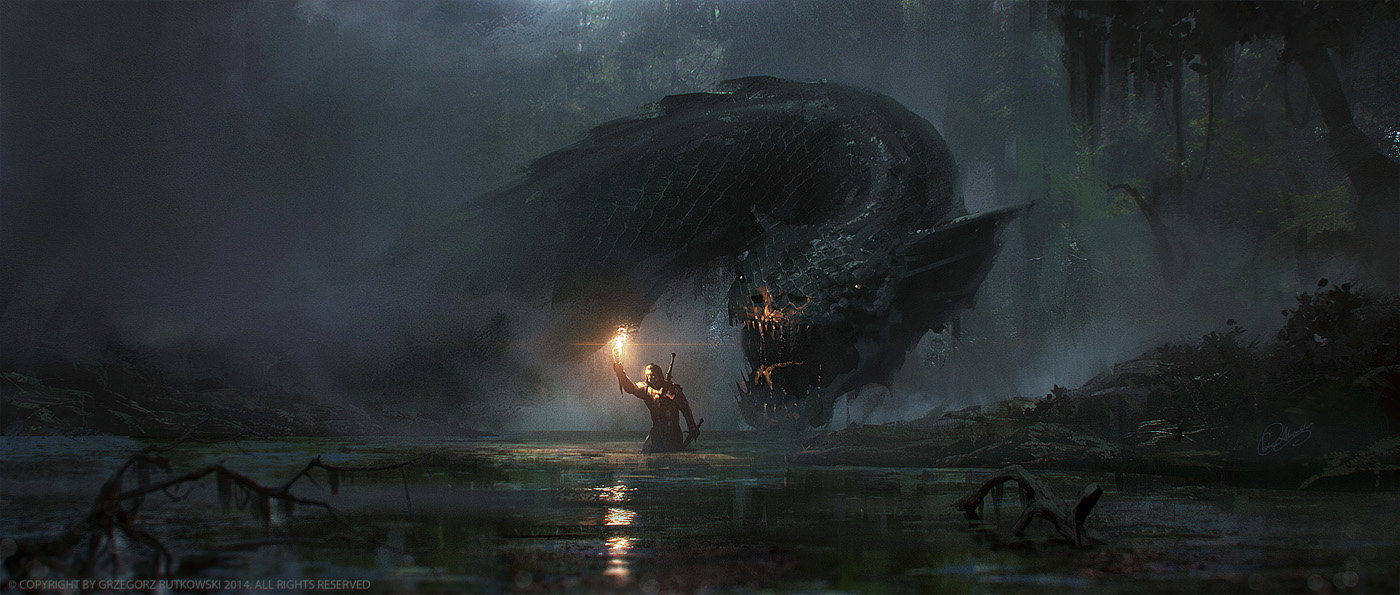
Swamp Ambush by Greg Rutkowski

Saturday, June 1, 2019

UA Artificer v2: Tool Usage

WotC's new artificer UA has many traits that are cool, confusing, and interesting. One of these is that the artificer can use a set of artisan's tools that it is proficient in as an arcane focus. This particular box especially caught my eye as an interesting aspect of the artificer to explore:


Keith Baker hit a similar conclusion and similar beats to me on the potential this has for really distinguishing your character and providing unique flavour to your spells and other class abilities. It's worth noting as well that an artificer can be proficient in multiple tools, and whilst they may specialise in one or two, there's nothing stopping them having a variety of options for invention origins.

Please see Baker's post for some examples of this; read on below for some alternatives and additional thoughts on how spells and subclass traits could work with tools in mind. I've left some out but will go back to them in time.

Alchemist's Supplies: Potions, salves, and poultices. Some must be thrown or applied directly to the target; others require mixing just before creation, breaking down and reapplying. You could alternatively go the Fullmetal Alchemist route, though this is likely more a combination of tinker's tools and loosely applied alchemical theory.

Brewer's Supplies: Your tools have given you experience in short hours of work followed by a long duration of waiting for the best results. Your tools can be used to distill and purify. You know just the stiff drink to get a good night's sleep and cure a wound or two along the way.

Calligrapher's Supplies: Baker's ideas of writing the words of the spell or reading them off of paper are solid choices here. Though this may be classified more under painter's tools or an independent tool set entirely, I also like the idea of artificer tattooists, channeling magic through ink and skin, constantly patching up their work as the magic burns out and the ink fades away.

Thursday, May 30, 2019

10 Monster Setting – Absolem's Pearl

This is my response to #tenmonstersetting by 3 Toadstools. For this one, I've gone without the suggested creature categories, and all creatures have been taken from 5th edition Dungeons & Dragons.

Underwater by Kiarya
Absolem's Pearl is the lair of the eponymous Absolem, a morkoth that has travelled across the planes on its rocky vessel of petrified dead gods. Kept hot and humid, the lair's ecology is based on the trinkets and 'pets' that Absolem grasps. Once they've landed on the Pearl's beaches and traversed into the coral forests, there is little escape from the morkoth's clutches.

In Absolem's infancy, many of their attempts to collect shiny trinkets and baubles fell prey to the deceptive ploys of mimics. The Pearl is now infested with these ambush predators, leaving adhesive trails across the rocks and shorelines as they take the forms of half-buried swords and hidden escape hatches. Some older mimics have gained great size, becoming curiosities that outweigh Absolem's original desire for whatever petty object they were presumed to be at first.

Mimics have found larger, but simpler-minded prey on the Pearl, allowing them to take on simpler disguises to lure their dinosaur victims. These huge reptilians provide much of the food, heavy labour, and transport of Absolem's loyalists. Many have adapted beyond their initially recognisable forms as they have become more accustomed to an amphibious lifestyle.

Reef by Tim Blandin
The Pearl's riches and captives lure many adventurers to seeking it out; an endeavour that Absolem happily encourages; many of the morkoth's most prized pets are champions, dominated and conditioned into being servitors for their new god. Few of these adventurers last long without getting used to dinosaur steaks and learning to be paranoid of every object around them.

The descendants of Absolem's first prisoners have been shaped by a world of hunting dinosaurs for food and being hunted by shapeshifting ambush predators. Relying on senses beyond their vision to avoid mimics and becoming more zealous and feverish in their worship of the morkoth, these grimlocks consider themselves the chosen ones of Absolem, birthed from rock and salt, created to worship him so that they may one day tear away the skin that covers their eyes and behold the treasure troves of the paradise they live in.

The grimlocks are led by Andromeda, a medusa that has resigned herself to her current fate, simply content that the champions that cross her path are typically too busy trying to run away from an allosaurus to try and challenge her. The grimlocks see her as a powerful sorceress, able to kill enemies before she can smell or hear them. She assures them that one day they too will see, and sends them on errands to fill her demi-lair with treasure and jewels to adorn her sea krait hair.

Not all creatures on the Pearl are inherently prisoners; the berbalang see themselves as seasonal guests, for Absolem makes no attempt to force them to stay. Their ability to whisper to the bones of the dead and be whispered to in return allows them to learn of the whereabouts of lost treasures, which they barter and trade with Absolem in return for access to more precious skeletons or locations of other oddities. Absolem worries that the berbalangs may offer the same services to other residents of the island.

The apex predators of Absolem's Pearl are the various chimera that Absolem pulls through. Somewhat of a pet project, the morkoth finds itself heavily interested in the mix-match creations of cultists and transmuters, bringing the oddities onto the island to observe the interactions between the various creatures. No one chimera looks the same,

Chimeras are, however, not Absolem's truly desired prize. Above any relic, artifact, or slave, what Absolem truly desires is a unicorn of their very own. Several have, over the centuries, found themselves ripped from their woodlands and placed in a barnacle-encrusted world. Their bodies wasted away as the plants they tried to summon got drowned in brine and their connection to the natural world faded away. From their cadavers, corpse flowers have bloomed. These roaming plants provide nutrients to dinosaurs, and the herds of grimlock corpses- easy to gather due to the grimlock's heightened smell making them more vulnerable to the flower's pollen- provide both food for mimics and protection from trapped adventurers.

Underwater Coral Forest by Veikka Somerma


Adventure Hooks (idea taken from Archon's Court):

  1. A t-rex has started to show signs of a corpse flower growing on its flesh. If the plant isn't destroyed before the t-rex's necrotised wound claims it, the flower will have a giant skeletal dinosaur army at its disposal.
  2. A berbalang has found the location of a powerful magic item, and is receiving offers to trade from both Absolem and Andromeda. It needs help deciding which offer to accept.
  3. The grimlocks have been infiltrated by an intelligent mimic, but without the ability to see, they cannot tell which is the imposter.
  4. Absolem is on the lookout for a mage able to create some dinosaur chimeras. They've spent so much time wondering whether they could do such a thing that they completely ignored the question of whether they should.
  5. A champion ancients paladin has purposefully been captured in order to rescue the most recently abducted unicorn. She needs help to do this, and the grimlock cultists are hot on her trail.


Creatures used:

  1. Morkoth - Volo's Guide to Monsters, pg 177-178
  2. Mimic - Monster Manual, pg 220
  3. Dinosaurs - Monster Manual, pg 79-80; Volo's Guide to Monsters, pg 139-140
  4. Champion - Volo's Guide to Monsters, pg 212
  5. Grimlock - Monster Manual, pg 175
  6. Medusa - Monster Manual, pg 214
  7. Berbalang - Mordenkainen's Tome of Foes, pg 120
  8. Chimera - Monster Manual, pg 39
  9. Unicorn - Monster Manual, pg 293-294
  10. Corpse Flower - Mordenkainen's Tome of Foes, pg 127

Monday, April 15, 2019

Consider the Fomorian

I've been a bit AWOL recently after a rather productive spurt. I shall be trying to get back into the swing of things soon! To start things off, let's have a look at one of D&D's monsters that come from Irish mythology...

No one is entirely sure where the fomorians got their curse from. Some say it was archfey that forced them to show their internal ugliness on the outside. Others believe it was the gods, for the fomorians themselves give praise to no higher or lower powers. Perhaps they were once gods themselves, cast down by other divines for their cruelty. Mages speculate their attempts at fully mastering magic backfired, or that they are the result of exposure to arcane fallout.

The fomorian curse is focused on the malice and cruelty in their hearts. The more wicked a fomorian's thoughts and intent, the more disfigured their bodies become. This results in an almost neverending spiral, as the uglier the fomorian becomes, the more spiteful and self-loathing it feels.

No two fomorians turn out entirely the same. Some are covered in warts and monstrous growths; others have vestigial twins embedded in their flesh; some look angelic but reek like cesspits and speak like scraping metal sheets.

The Fomors by John Duncan

Saturday, April 6, 2019

Reptilian Campaign

A friend of mine recently proposed running a campaign based on Dinosaurs of the Wild West by Shaun Keenan.

Image from Shaun Keenan's ArtsStation.
I chatted with him about potential ways that the idea could be used, which in turn led to him making the following (abbreviated) setting premise:

Long ago, the divine pantheon split into those that would strike out against the devils and those that would not. The warring gods were victorious, but in doing so disrupted the power struggle between devils and demons, resulting in demons breaching the surface world. To destroy them, the gods that had avoided hell used much of their power to banish the fiends back to their pits and lock their more violent brothers away, turning them into the new archdevils. This war caused mass arcane fallout, making a world where those with thicker skins (figuratively and literally) could endure moreso than others. This is the age of reptile supremacy.
Whilst it does detract from the simplicity that was dinosaurs in the Wild West, I ran with the ideas a bit further to see how players would actually interact with these concepts in a way that their characters would know and understand. Here are a few ideas that I'm especially happy with.


Gods & Devils

I am under the assumption that my friend was planning to either use or heavily be inspired by the Forgotten Realms pantheon, with Tyr as the god that headed the fight against the archdevils. With this in mind, the trapped gods are now the new archdevils. From this, you gain two pantheons; the pantheon of Old Gods that ended the great war but are now drained of power, and the pantheon of Fell Gods that have increased power but at terrible cost. The new archdevils take their duty- fighting the demons- seriously, and only they truly know whether they feel remorse for the position they now find themselves in.

All sacred animals and relevant symbols are of course replaced with dinosaurs and other large reptiles.


Tiefling Martyrdom

The first tieflings could mostly be paladins & clerics of the old gods, meaning tieflings (at least some of them) could be a very religious/zealous lot, seeing their makers as martyrs instead of evil entities. It could be a strange surprise for people to see these infernal humanoids practicing the same faiths they do, just as pious and humble as those around them. They know their forefathers fell from divinity out of their belief that they could make the world safer, and they still hope that if their gods can break free of the prison, they can continue their good work and fix the mess that the material plane now is.


Skull Collector by Raph Lomotan

Mammalian Underdark


Deep beneath the earth, the underworld houses an echo of what the world could be now; one without dinosaurs and reptilian overlords. It is a cold, harsh place, dwelled in by strange mammalian goliaths: cave mammoths, echolocating terror birds, pale smilodons. Hidden in small communities, shamanistic neanderthals hide from the cavern beasts and praise the remnants of the god war that have fallen through the cracks of the earth.

I pitched this idea to myself as an underground ice age. Imagine traveling through caverns and tunnels with low light and food, but everything is cold, covered in thick snow or slippery ice, and there are sabre-tooth cats lurking around the corner.


Watcher of the Ancients by Bjarke Pedersen

Giant skeletons

In my friend's original idea, the remaining gods that fought the demons used an army of giants and dragons to fight them. Whilst some dragons survived to help introduce the age of cold blood, the giants fell in battle.

Their skeletons litter the land, ripe for taking by those skilled with necromancy. In this land, 'undead' does not invoke memories of shambling hordes, but of gargantuan striding beasts that rise from the sands, called to new wars beyond the grave.

I am reminded of the Japanese gashadokuro: giant, invisible, vampiric skeletons.


Bound devils

People make pacts with weakened devils, binding them to objects to access their power. Some call them artificers, but others know the real truth. How else do their crossbows shoot hellfire bolts, or their cloaks shrug off damage and reveal a winged, horned shadow standing behind them at all times? What is devil worship but another kind of prayer? Can any of the believers in the weakened gods above claim to have communed with their lords face to face, to have shook their hand and left with blessings?


I'd also highly recommend checking out Goblin Punch's mutant dinosaur generator, as well as their dinosaur cleric. It's a cool idea that could be fun to play with.

These ideas definitely aren't the most directly related to Wild West Dinosaurs, which is possibly why I like them- they can be used for other things outside of the initial premise.