
I was sent this post recently, and having both a soft spot for bullet point worldbuilding and gorgons, I wanted to have a go at expanding on this concept a bit.
The tale of Saint Orabella is one of martyrdom and monsters: her homeland decayed under the weight of their corpulence and corruption. Distraught at what she saw, Orabella prayed to take on the sins of her people so that they may be given a chance to start anew and redeem themselves. In doing so, she was transformed into a gorgon, and her church cast her out as a monster. Orabella held onto her faith for the rest of her life, until another saint slew her as part of their journey.
Knights that seek to emulate Saint Orabella - to take on the burdens and sins of those around them, to endure deformity and exile for their faith and the betterment of others - may find themselves entering her sect. Entering her cathedral, they are watched by stone sentries, their faces wrought with looks of defiance, endurance, and exhaustion. The cathedral's interior is plain. At the far end, an altar awaits its worshipers; held atop in the caring hands of a headless statue is a relic, covered in a thin veil of silk.
The severed head of Orabella.
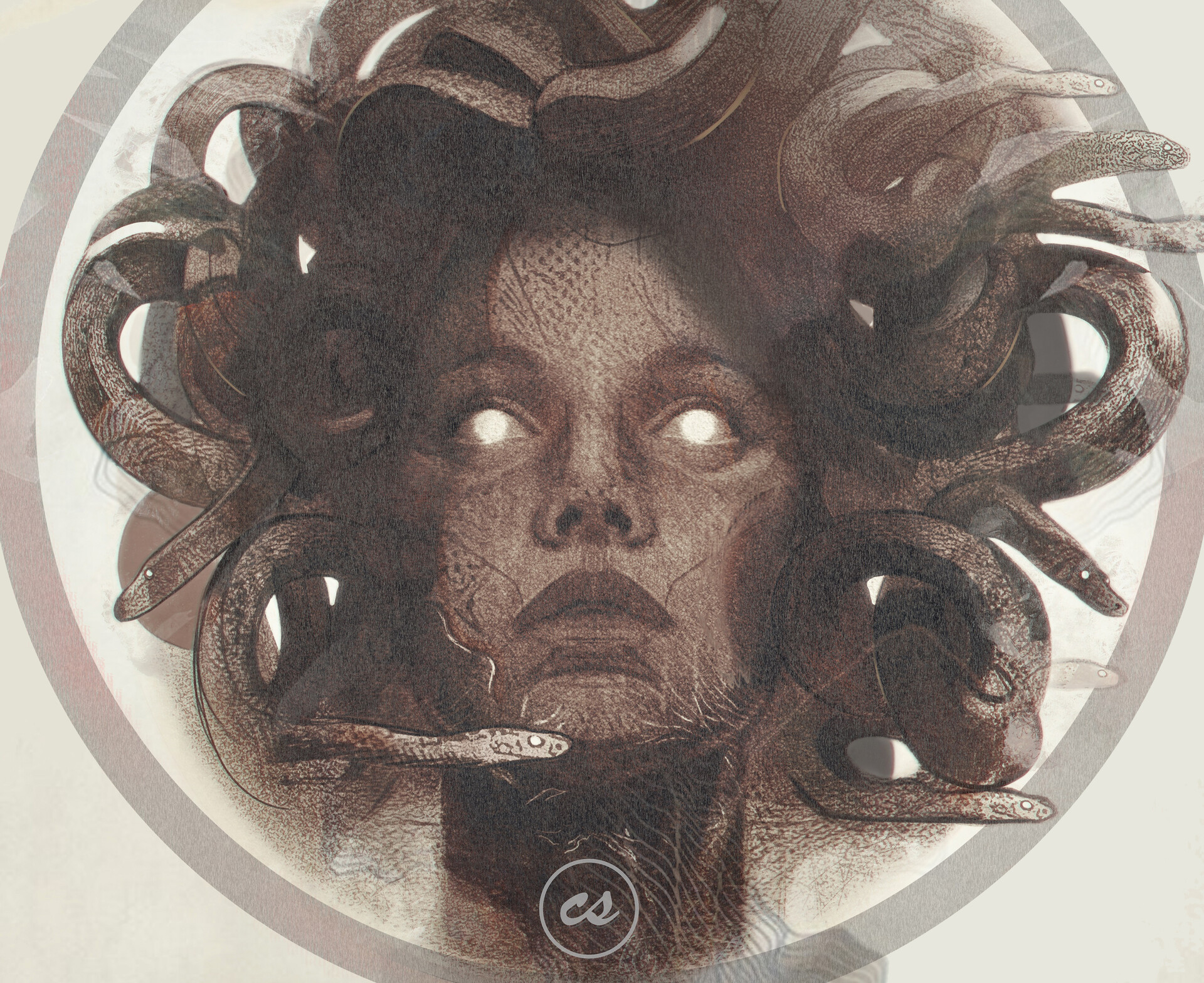 |
| Medusa Head by Shafiq Cromwell |
Exactly why this happens has been interpreted in many ways. Some argue that temptation is not something that can be resisted forever by mere mortals, and the petrification takes its hold over all because they are simply human (or whatever other species they may be). Others claim that the 'blessing' of their saint is simply a curse given by a monster, and that the knights are clearly deluded for seeking power from a monster's affliction.
The knights bear their marks with subtlety at first. Their eyes look weary, sometimes reddened and weeping. Their joints ache and muscles tense without provocation. Though their skin may be clean and youthful from the constant use of healing salves, the smell of alchemical ingredients clings to their body, and over application may stain their skin in time. It is this staining and reliance on alchemists that has led to this sect being ousted in the past; few alchemists are willing to withhold details of their clients when a templar inquisition is at their doorstep.
The excommunication and imprisonment of these knights has been kept a close secret, for knowledge of splintering within the templars - or that this splintering was due to the praise of a saint turned monster - would do little to aid their efforts in maintaining control and praise of the common folk. Justifying bloodshed and raiding in the name of their lord is hard enough without including severed heads and petrification into the mix.

