Showing posts with label dragon. Show all posts

Sunday, September 13, 2020

An Alternative Dragonborn Origin

In times of old, human ancestors killed the dragons. In their dying breath, the last ancient dragon proclaimed that dragonkind would return once more, and that their return would take root in the hearts of their murderers.

This prophecy was forgotten over time, and the dragon slayers carried on with their lives, growing rich on dragon treasure and passing on the tales of their exploits to their children and grandchildren. But over time, one generation after another, they began to change.

First it was a few scales, or a change in eye colour. Then came the sharper teeth, the forked tongues, the sharpening of claws. From this came the dragonborn.

The current dragonborn people vary in how distinct their features are. Future generations of the dragonborn - or perhaps more recent members, with enough inbreeding or exposure to magic/dragon thoughts/ancient treasure - will become dragons entirely, bringing them back into the world once more.

Dragonarii by Rodrigo-Vega


What this means for your game:

Mechanically, dragonborn remain the same as usual. If you wanted a 'lower' dragonborn with less prominent traits or a 'higher' dragonborn with more prominent ones, you could look at the Shed Skin trait given as an optional ability for Yuan-Ti (Volo's Guide to Monsters) or lizardfolk traits for inspiration. You could optionally look at giving some feats that exemplify these traits further if plot-reasons came up for the metamorphosis to speed up.

This lore works well for games where dragons are more prominent individual entities as opposed to a large-scale presence. Think more Lord of the Rings than Flight of Dragons. Dragons that exist likely have names and stories to tell, either of how their non-dragon parents raised or abandoned them, or of how they were once more human, but changed into what they are now. You could also draw inspiration from games like Skyrim, where dragons are returning to the land and there is history and lore associated with their sudden return.

In this lore, dragons returning is a gradual process over multiple generations, but there's no harm in having this be a more erratic process. It could alternatively be based on time rather than generations; a planetary event could induce the direct descendants of the dragon slayers to metamorphose at once in a cicada-esque day of screaming and fire.

Dragonborn and half-dragons are essentially one and the same as far as anyone is concerned; only dragon-lore scholars would be peculiar enough to distinguish the two. Humans are sort of well known for trying to bang anything that moves, so it is also feasible to get dragonborn/half-dragon giants, minotaurs, elementals, elves etc.

For more recent dragon emergence, current dragon statblocks would instead represent how 'pure' a dragon is; dragon wyrmlings are akin to dragonborns with wings, whilst adults and older become more obviously dragon and less humanoid.

Not quite sure what this implies for draconic sorcery. If you have any thoughts, leave a comment and let me know!

Sunday, September 15, 2019

Tolkien's Dragon-Spell

The Glance of Glaurung by Alexey Rudikov
In Middle Earth, dragons have an ability known as the dragon-spell. This is essentially described as a kind of hypnotic voice/gaze, allowing them to manipulate humans and elves to their will. Dragon-spell could create feelings of distrust, influence the target's perception of the truth (as with Smaug), and even lead to total memory loss and madness (as with Glaurung).

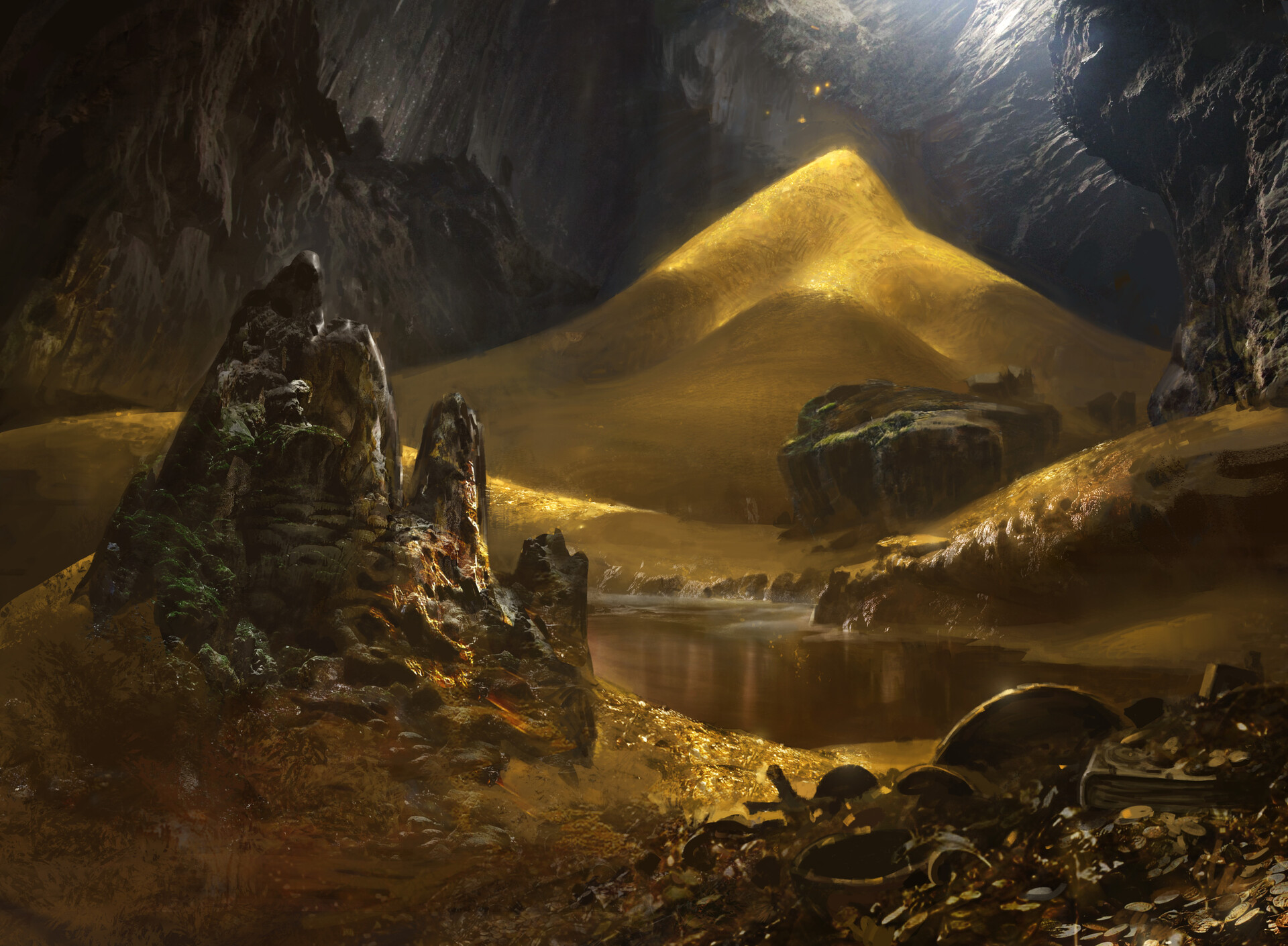
This ability has been connected to dragon-sickness, in which individuals exposed to a dragon's hoard (especially after the dragon's death) can be overcome with greed.

Further information on these can be found at A Tolkienist Perspective and the Lord of the Rings Fandom Wiki.

I wanted to have a go at making these traits into mechanics that could be used for dragons in tabletop games, using D&D 5e mechanics for this entry with the knowledge that they could then be converted into other systems as and when needed.

Sacrifice to the Green Dragon by John Tedrick

Dragon-Spell

Dragons with this capability gain the following additional traits:

Roving Eyes. The dragon targets one creature within 120 feet that can see the dragon's eyes. The target must make a Wisdom saving throw or be charmed by the dragon. At the end of each hour, the target can repeat the saving throw, ending the effect on a success. On a successful save, the target is immune to this dragon's Roving Eyes for 24 hours.

Serpent's Tongue. if the creature can understand the dragon, it must make a Charisma saving throw or become influenced by the dragon indefinitely. A creature that cannot understand the dragon is unaffected by this ability. Before the saving throw is made, the dragon chooses one of the following effects to apply to the creature if it fails the saving throw:

False Truths. The dragon manipulates the target's perception of the truth, creating feelings of greed, loyalty, distrust, or any other desired mindset.
Memory Loss. The dragon clouds the target's memories, causing partial or total memory loss. The dragon can only remove memories in broad strokes (e.g. "your childhood" or "your time in the castle").

The effect can be ended early by the dragon speaking a command word as a bonus action, or by a remove curse, greater restoration, wish spell or similar ability.

Dragon Sickness

This counts as a curse that starts when a dragon dies. Within 1d4 hours, the hoard becomes infested with the curse. Any creature that comes within 30 feet of the hoard must make a Wisdom saving throw. On a failed save, the creature is afflicted with dragon sickness. On a successful save, the creature is immune to this hoard's dragon sickness for 24 hours. A creature with dragon sickness gains indefinite madness (DMG, pg 258-260), adding the following flaw to their character: 

"protecting the hoard is all that matters to me now."

The character puts the hoard above all else, and the hoard intends to keep things that way. At the DM's discretion, a particularly large hoard may also provide the following effects to a cursed individual:
- They only eat and drink half as much as a regular person, and sleep half as long
- They are immune to disease
- They have advantage on saving throws against being charmed or frightened
- They age at 1/3 of the rate of their normal race

Dragon Sickness can be cured as with any other indefinite madness. At the DM's discretion, a character may also be able to repeat the saving throw after an extended period of time away from the hoard, or if their desire to protect the hoard conflicts drastically with their character bond (such as with the case of Thorin choosing between the hoard and aiding his allies in battle). Should additional effects be used, the target returns to their own mind with 1d4 levels of exhaustion (no more than 4 total) and their age catches up to them.

Dragon's Hoard by Adam Paquette
I would potentially consider also adding this effect to magic items within the hoard as a curse, similar to the effect on items stolen from the lairs of Mummy Lords (MM, pg 229). Straight up taking the specific regional effect would also work fine.

I also feel that these abilities would work well together with the 'words of power' used by dragons in Skyrim; perhaps instead of traditional breath weapons, they use effects similar to power word stun, power word pain, or power word kill?

Saturday, January 5, 2019

An Alternative Kobold


Ribbons of meat falls from the dragon's flank, splattering to the ground in a grotesque cluster. The beast roars in pain and vengeance. Dragons are chaos and sin made manifest, and their whole being is driven by the desire to be mighty and powerful. Their still-warm flesh still holds this drive, and wills itself to continue the pursuit. Slowly and clumsily, the flesh begins to stir, slithering and dragging itself into piles. They wind around each other, grafting into shape.

Kobolds are flesh given thought. Scraps of offal and fatty layers filled with greed, wrath, and envy. One spends its first few hours of existence without bones. As the mass attempts to regenerate, energy is focused into the head, providing a maw to bite and teeth to pierce. The kobold has little need for other bones: all the better to wriggle through gaps and squirm into people's houses.