- They must focus centrally on creatures, or the interactions between creatures and society
- They must have multiple ways to pass through them
- They must still allow players to engage in typical RPG activities
Here are some of the quests I came up with. Creatures that use lore from D&D are written in bold, but all can easily be changed to other creatures based on your system and environment.
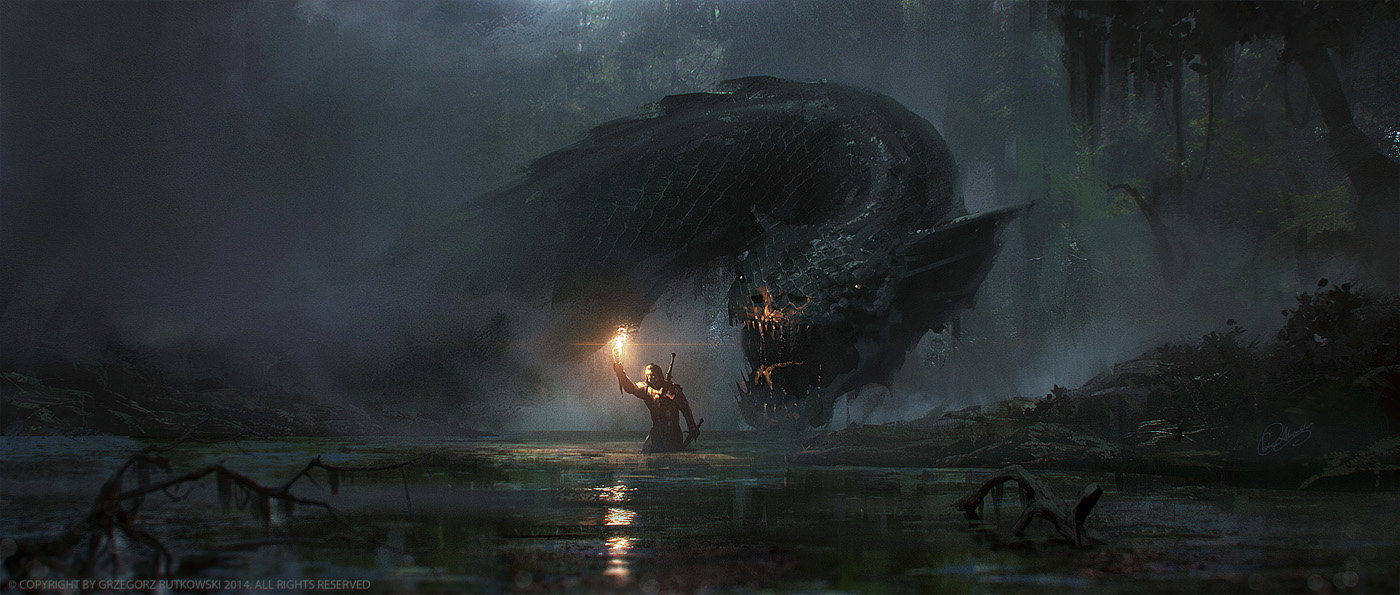 |
| Swamp Ambush by Greg Rutkowski |
- A creature has been pushed out of its natural environment, forced to live in the encroaching settlement to steal food and shelter. Should it be re-homed, or should the city learn to adapt to this creature?
- A pair of perytons are preparing to mate; as part of the ritual, they seek out human hearts for their nest. Should they be prevented from continuing their species? Should alternatives be researched?
- Plans are being made to reintroduce an otyugh into the wild after it has been used for many years as a waste disposal unit. However, otyughs eat a lot of food, can be dangerous if provoked, and this one is now very used to urban environments and to people. What is the best course of action?
- The leader of a settlement/faction has fallen ill, and their people believe that a specific medicine is needed to cure the sickness. This remedy is made from the body parts of several magical creatures. Can an alternative medicine be found, and can this alternative be diplomatically offered? Can the creatures be protected from the hunters sent to collect them?
- An assassin has trained a venomous creature to take out targets on their command. The creature must be identified for an antidote to be made, and this must be done before the creature is sent after a specific target (perhaps the people trying to stop the assassin are at risk of being hunted themselves?)
- A renowned hunter has set their sights on taking down a magical creature. Upon being stopped, they set their sights on the protagonist(s), marking them and the creatures they protect as their prey. The hunter knows beasts just as well, if not more so, than the protagonist(s), with the added advantages of having training in stalking and killing said creatures as well.
- A dangerous creature is being kept in a DIY enclosure by a civilian. The civilian shows promise as a wildlife keeper, but they're overly attached to their 'friend', and the creature is getting bigger and its appetite less easy to satiate.
- Mages are searching for new monstrosities to merge together for their experiments. Does the protagonist help them to make new life, or refuse to pervert the course of nature? Do they see the end results as monsters to destroy or creatures to protect? How do they choose to deal with a potential invasive species?
- A behir is slowly approaching the territory of a nest-brooding dragon, likely seeking to devour the hatchlings. Should it be stopped and left hungry, or allowed to feed and risk the consequential wrath of a heartbroken, angry brooding dragon?
- A resident villain has recently been defeated, and their collection of war beasts are now needing new homes. If homes aren't found in time, they will be exterminated (alternatively, some of them manage to escape their confinement part way through)

Just another day at work... Griffin by Jakub Rozalski - An intelligent, sapient predator- such as a manticore or dragon- is hunting down people. It could be captured, but it will likely return and attack people again. Are some magical creatures simply too dangerous to be kept free?
- A settlement with a rapidly increasing population but limited resources relies on butchering a rapidly healing animal for their food. The creature must be saved, but should this come at the cost of the survival of the settlers?
- A creature (e.g. dragon, mimic, döppelgänger etc) takes the form of a human and is causing chaos with their actions, either as a complete stranger or in the form of someone else. How is the creature found, and how are they convinced to stop causing so much mischief?
- To get rid of some local pests, the local noble had decreed the release of non-native predators to eat the pests. This hasn't ended well, and now the noble is commissioning mages to magically create yet another type of creature to deal with these predators. Can the noble be shown that this isn't the solution? What happens if these artificial creatures- perhaps something like slaad, able to inject prey with their eggs- have already been created?
- Many decades ago, the last dragons were removed from the land, allowing farming and settlements to be made in safety. Now there are talks of reintroducing dragon hatchlings to their old territories. Should civilisation give way to these native creatures, or the reintroduction stopped, or is any hope of compromise possible?
- A unicorn has been sighted in a nearby glade, and poachers wish to hunt the beast, as its horn can cure any illness and the land was recently ravaged by plague. Finding the unicorn to either defend or hunt it is difficult, for it is a flighty beast that can command the beasts of the wilds to its will.
- A wizard's recent attempts to take control of the weather have caused strange migration patterns and behaviour in local animals and plants alike. Shambling mounds are created from the lightning storms, and giant worms rise from the earth due to the heavy rain. The wizard's experiments are potentially groundbreaking, but are the risks worth it?
- A circle of druids has decided that an archive of life must be formed, collecting and raising different creatures so that their species are preserved even if wild populations go extinct. They need help collecting some more... unusual creatures, and would be very happy for help from any willing adventurers that are able to bring the beasts back alive.
- To grow more crops, villagers want to cut down a section of forest. They want help assessing if this will cause long term issues, as well as dealing with any dryads or other such creatures that may need negotiating with. Tensions rise as the forest creatures don't want to see their home taken away, and the farmers become more impatient to begin work.
- A swarm of creatures is due to emerge soon and start a new nest. Whilst swarming, they are aggressive and hungering, and several settlements in the nearby area want aid in diverting them away from their homes.

No comments:
Post a Comment