Sunday, August 25, 2019

Response to A Tradition

I haven't posted anything here in a while, and I often find the best way to get back into blog post writing is to start off with something simple and keep that ball rolling. So for today, I decided to respond to the following Tumblr prompt by sonatagreen (original post here):

In peacetime, the ruler grows their hair long. In war, they cut it short.
A ruler with long hair is held in great esteem, for defending the peace.
The traditional declaration of war is for the ruler to send their cut off hair to the enemy ruler. The statement carries greater weight the longer the hair: the receive long hair says that you have angered one who is slow to anger, that you have incurred a wrath not easily woken.
And here is a response by wakor-rising that was included in the screenshot I initially saw of the post:

Violent war-mongering leader frantically and aggressively tries to shave just a LITTLE hair off the top of their head into an envelope.
A faraway king receives a heavy wooden crate filled with a coil of the longest hair he has ever seen.
A despised ruler finds hundreds of pounds of cut-off ponytails at her castle entrance, each one belonging to her own people.
A young emperor refuses to cut their hair and insists on trying to make peace with invaders. The enemy leader steps forward, draws their blade, and cuts the emperor's hair themselves.
Hellen cuts her hair off and throws it in Cathy's face at her son's soccer scrimmage.

The notion of hair as a symbol of power and the symbolic losing of one's hair isn't a new concept. In the Hebrew Bible, we have Samson, who gained supernatural strength from being a nazirite (an Israelite who, amongst other things, allows their hair to grow long and doesn't cut it). When his hair is cut, Samson loses this power. A more recent take on this theme can be seen in George R R Martin's Dothraki, who braid their hair with bells after each victory and have their hair cut as a symbol of shame upon defeat. Culturally, we see hair and its presentation have prominence in multiple cultures, as a sign of power, life, beauty, and civility.

So the idea of hair as a sign of stability definitely has roots in real life and past fiction. The notion of cutting hair short in times of conflict also serves as a good practical practice: just as horse tails may be knotted to stop people using them for leverage, so too might rulers wish to have short hair so it cannot be used against them in combat.

Of course, there are multiple factors that could also come into play in such a culture, which add a lot of depth to such a setting. For example, methods of masking the true length of one's hair: in ancient Rome, Caesar hid his thinning hair with a laurel wreath, as a full head of hair was seen as desirable. In a similar way, rulers with short hair may use hair extensions or wigs to mask the true length of their hair, whilst hats and crowns may be seen as obvious forms of deceit, and as such be seen as unfavourable for a ruler to wear. Rulers who aren't gifted with long locks may have to seek other ways of providing large quantities of hair, such as having professional 'hair growers' to harvest from.

There is also the potential for scalping: forcibly removing hair - roots and all - from the scalp, leaving the victim with heavy scarring and the inability to grow hair in those areas. This would surely be seen as a ruthless form of defeating or humiliating a ruler. Alternatively, it could be seen as a dishonourable act on the part of the aggressor, as it gives the victim no option to participate in this culture of peaceful presentation and forewarning of battle.

Societal customs outside of nobility could also show influences from this practice (as in the case of wakor-rising's soccer game). People with long hair are seen as more level-headed and reasonable whilst those with short hair are more temperamental and violent. Barbers may hold a higher status, given their profession of shaping and shearing this status symbol. Those with long hair may wear protective head garments to stop others from cutting it off - assassinations of character may come in the form of skulking into rooms at night with scissors, providing temporary shame without risk of bloodshed or the crime of murder.

A final point I will bring up is that if this took place in a setting with magic, then there is the potential for a lord's challenge to go poorly for them if the ability to curse people with samples of their body parts is present. As in fictional depictions of Voodoo dolls, a ruler's hair could be used to harm them, and as such this cultural practice may require extra precautions in order to be done safely. Alternatively, the potential for curses may make the declaration of war that much more prominent, given that the ruler is willing to risk their own life and chop off their symbol of peace and strength in order to declare battle against an enemy.

Sunday, July 28, 2019

Selkie Race for D&D 5e

In a similar time frame to making my medusoids, I also made a race block for selkies, a creature from Scottish folklore that is essentially a sensible response to the Mermaid Problem but with seals instead of fish.

The Selkie by Kitty-Grimm

Here's the lore part I included:

The elusive selkies or seal-folk are mostly known of through sea shanties and bard songs; typically the tales of fishermen that steal their pelts and coerce them into marriage. The pelt must be hidden, for as soon as the selkie finds her pelt, she returns to the sea and is never seen again.

Few selkies that choose to interact with the surface world are open about their origin, predominantly due to these tales. Those that are not deterred by these stories tend to come to land to either learn more of the strange world of air and sky, or to seek vengeance for the hunting of one of their kin or the polluting of their homelands.

A selkie without their pelt is near identical to a human, bar some unusual skin blemishes akin to seal spots and the smell of salt on their skin. The children of humans and selkies are less fortunate; they are born with webbed hands and feet, with a rare few born with even more seal-like traits. These individuals may be kept on land by their human parent as a reminder of the love they once had, or rejected and cast out into the cold seas that are no more their home than the harbor towns and fishing villages they were born in.

I've also included a rough statblock for a generic seal, given that there wasn't one already (I mean, there's the sea lion, which could maybe be a form obtained later on as a feat or something?)

To read the racial statblock, check out the link here. The art in the document is Vengeful Selkie by BeaGifted.

Sunday, July 7, 2019

Medusoids: Jellyfish people for D&D 5e

Just a quick post today, sharing a brew for jellyfish people inspired by Caitlin Soliman's art, especially her jellyfish-themed mermaids:

Here are just a few of them!
As a bit of lore for them:

Watchers of the tides and archivists of history, the medusoids measure their lives not in years, but in aspects: units of time defined by going from one life to another. As one aspect withers, it is rejuvenated into an infant state, equipped with knowledge from its past lives and a fresh, new outlook on the future.

Medusoids that answer the call to adventure do so due to a need to change the world they have witnessed for so long, either to restore some constant balance or to instil long-needed change. Though not physically strong, they compensate for this with great knowledge and an array of nematocyst-ridden tendrils emerging from their bodies.

Tales from the surface speak little of the medusoids, other than sailors telling drunken tales of singing jellyfish, ghosts of drowned wives-to-be, and strange findings of translucent clumps of vaguely humanoid flesh washed up on beaches, clean of pecks by any seabirds.

To read the racial statblock, check out the link here.

Monday, June 24, 2019

Game of Mold: Assorted Notions

I found this video a while back. It's pretty neat.


It inspired me to try and make some kind of politically-charged fungal setting, but I haven't yet honed it down to its key components or what the general notion of the setting is. I still got some ideas down that I feel like sharing though.

This is a world of decay, where fungal houses fight over territory and power. Politics is dealt through spores, mycelium, and control of organic matter. The setting's land is heavy in themes of decomposition and rebirth. The living die and are reborn once more in new bodies, ready to feast upon the dead and die once more.

Through the Southern Gate by Cze Peku
The noble Houses are fungi. Their territory and their physical selves are one and the same, making them all very dedicated to their cause. Each has its own names (never only one), desires, smells and preferred substrate.

The houses have always struggled for power, and have been doing so since the First Flesh died. The world is built on layers and layers of composting political parties and failed rallies.


Cordyceps by Jacob Dunkan
Titans of past civilisations and worlds still stand, slowly encroached with lichens and fungus.

Fruiting bodies spread their spores throughout the land, creating an ever-constant mist. Vague whispers of slogans - "ours is the cure", "death is not the end", "untied we rot" - drift through the clouds, subtly influencing the behaviour of humanoids and beasts alike.

On the Shore of Dreams by Cze Peku
The Dreaming. The collective world of ancestral subconscious; hallucinations of the dead and dying, live and living. Sometimes spores and creatures lose themselves here, becoming more sensory entity than physical. These creatures are abstract forces of synesthesic being, and they have escaped decay by exposing themselves to mental decay. As long as they are sensed, they exist.

Mushrooms by Anastasia Wyatt
There are living beings here. The next generation of fertiliser, or the descendants of detrivores and fungivores. Ghouls, flyfolk, gnolls, and other such beings have been and gone. The fungus enters their bodies at a young age, grooming them into political weapons and tainting their bodies. Some have the gift to turn these infestations into weapons of their own, combining hedgemagic, basal druidry, and diplomacy.


Mushroom soldier by Maxim Verehin

The living that lose themselves to the infection become walking envoys of the houses. Visually similar to myconids but equipped with speech and eyes for a while. These envoys are invaluable to the houses - they provide a rare glimpse into the minds of their voters, allowing them to see where their allegiances lie. The minds of humanoids are as alien to them as a fungal mind is to us.

Meat by Maxim Verehin
A pastor of the Exquisite Corpse. His life and entrails are laid out before him, all the better for him to predict future omens and aid in medical research. Surely their power must be great, for none of their open wounds become septic- those that do are, of course, not truly faithful.

High Priests take offerings from their flocks of the sick and dying. These offerings of functioning organs are integrated into their own, allowing the priests to better love their charges.

The Exquisite Corpse is a faith of purity and fullness in one's actions. They teach that one must act with full intent of their actions, and that doing so will help them distill their essence and allow their bodies to reject external entities.
Assassin's Trophy by Seb McKinnon

The casualties of war between the houses are many. Fortunately, this one cannot speak of the atrocities it has seen.

Societies rise and fall throughout the layers of rot, and dedicated excavators can earn a living by trudging through the grime and bringing back relics that haven't decayed. The way is harried by giant worms, fungal abominations, oozes, and hidden guardians.

Parasitized Moth Warrior by Vasco Mariano

A fungal inquisitor infects and interrogates a dustknight. Their methods are curt and its questioning equally so. For some, infestation and decomposing before one's own eyes is enough to make one betray their house. For others, the inevitability of death makes their threats worth little.

Arachnid Knight by Chenthooran Nambiarooran
Mannimarco, The King of Worms by Shamine King
Left: a dustknight, plated in chitin and wielding large blades. Their oaths are made to preserve the memory of the living, to stop people straying too far into the Dreaming, and to fight against the final decomposition: the time at which there is nothing left to grow upon, and the final fungal bodies break each other down into dust.
Right: undeath is one of the ways to escape fungal enslavement. Mushrooms grow on dead things, and those that remove decomposition from the cycle are free from their influence. As such, the study of necromancy is rich, with liches wandering market streets alongside worms that walk.

decay by Vladislav Orlowski
Speakers of the Chytrid. An ancient household, noted for the slaying of many of the great Olms that hide in dead lands.

universal carcinogen scp - 135 by Vladislav Orlowski
A prophet's birth is rare indeed, and many lords hope for their death to bring about the coffin birth of the realm's next saviour.

Sunday, June 23, 2019

Campaign Concept: Queen Ascending

The adventurers have spent the first few levels hunting down the lair of a necromancer. Nothing unsurprising; the general dark cowl and bones aesthetic one would come to expect from a communer with the dead. The necromancer has seemingly been practicing new forms of raising undead and releasing their experiments upon the local countryside.

Summoner by Piotr Dura
Through valiant fighting and careful investigation, the adventurers have found the dark tower of their nemesis. They've scaled the staircase, avoided traps, discovered the true extent of the wizard's machinations. They burst through the final door, entering the necromancer's observatory, from which they can use the moon's power to fuel their rituals.

The fight begins. Spells are launched, blades collide, spectres shift through the floorboards to defend their master.

Then the tower walls explode. An airship has arrived. Three figures swing across on ropes, landing in the tower. One incapacitates the necromancer and shifts out of view, appearing on the ship once more. The other two draw their weapons, ready to engage the players.

Your necromancer has been stolen by githyanki raiders.

Saturday, June 8, 2019

d20 Zoology Quests

I've been planning a game based on Witcher-esque side quests, with a monster-of-the-week kind of scenario to them to make it easy to have short, contained sessions. Prior to this I had been asked to potentially run some games for a bunch of zoology students who wanted a campaign focused on wildlife and ecology. With this in mind, I set about making some quest ideas with the following parameters in mind:

  • They must focus centrally on creatures, or the interactions between creatures and society
  • They must have multiple ways to pass through them
  • They must still allow players to engage in typical RPG activities
Here are some of the quests I came up with. Creatures that use lore from D&D are written in bold, but all can easily be changed to other creatures based on your system and environment.


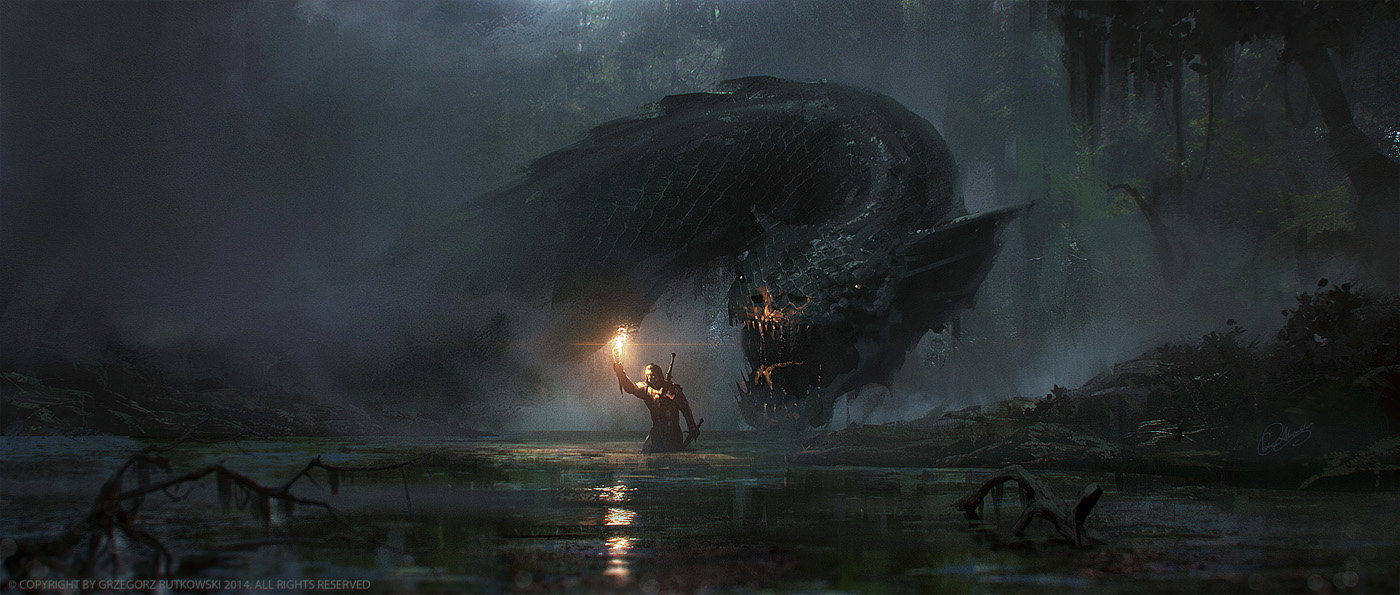
Swamp Ambush by Greg Rutkowski

Saturday, June 1, 2019

UA Artificer v2: Tool Usage

WotC's new artificer UA has many traits that are cool, confusing, and interesting. One of these is that the artificer can use a set of artisan's tools that it is proficient in as an arcane focus. This particular box especially caught my eye as an interesting aspect of the artificer to explore:


Keith Baker hit a similar conclusion and similar beats to me on the potential this has for really distinguishing your character and providing unique flavour to your spells and other class abilities. It's worth noting as well that an artificer can be proficient in multiple tools, and whilst they may specialise in one or two, there's nothing stopping them having a variety of options for invention origins.

Please see Baker's post for some examples of this; read on below for some alternatives and additional thoughts on how spells and subclass traits could work with tools in mind. I've left some out but will go back to them in time.

Alchemist's Supplies: Potions, salves, and poultices. Some must be thrown or applied directly to the target; others require mixing just before creation, breaking down and reapplying. You could alternatively go the Fullmetal Alchemist route, though this is likely more a combination of tinker's tools and loosely applied alchemical theory.

Brewer's Supplies: Your tools have given you experience in short hours of work followed by a long duration of waiting for the best results. Your tools can be used to distill and purify. You know just the stiff drink to get a good night's sleep and cure a wound or two along the way.

Calligrapher's Supplies: Baker's ideas of writing the words of the spell or reading them off of paper are solid choices here. Though this may be classified more under painter's tools or an independent tool set entirely, I also like the idea of artificer tattooists, channeling magic through ink and skin, constantly patching up their work as the magic burns out and the ink fades away.