
Monday, February 18, 2019
Consider the Kruthik
Kruthik are horse-sized raptor-mantids with the brainpower of a primate, driven only by the desire for food and the continuation of their kind. No one knows if they're natural, and few pursue the line of thought that would come from believing that anyone was crazy enough to willingly create them.

Saturday, February 16, 2019
Alignment Factions (Rough Draft)
EDIT 17/02/19: I have spoken to a few people about this system on Discord, and we've come to the agreement that, much like the Ravnica faction system this is based on, the system predominantly benefits casters. If I come back to this in the future- which I doubt I will do unless there is a lot of interest in it- I think what I'd do instead/as well is to make some traits that players gain as they level up/commit alignment-specific deeds, similar to feats.
The following are optional semi-backgrounds, based on old D&D editions applying alignment as much more concrete concepts with mechanical influence. These would work for games where DMs want alignment to be core forces in their world- perhaps to the extent where they are manifested as gods or core elements.
The following are optional semi-backgrounds, based on old D&D editions applying alignment as much more concrete concepts with mechanical influence. These would work for games where DMs want alignment to be core forces in their world- perhaps to the extent where they are manifested as gods or core elements.
When a player selects their alignment, they capitalise either good, evil, lawful, or chaotic. This trait becomes their founding alignment, which determines which alignment's traits they benefit from.
Each core alignment has a language. This language consists of body language, glints in the eye, and occasionally specific code words and dialects. These can only be spoken by those with the same alignment, and cannot be learned through other means. At the DM's discretion characters may get to learn the language of both their good-evil alignment and law-chaos alignment.
Neutral gets nothing right now because in the metaphysical war of polar ideologies, you don't get points for indecision.
Thursday, February 14, 2019
Consider the Nagpa
"Nagpas can't learn from that which isn't destroyed. Imagine how bewildering and terrifying a city full of life must be to them. is it any wonder that they seek the ruin of such places?"
When Jim Henson designed the skeksis, he "became intrigued with the idea of a reptilian race assuming control over a formerly splendid past society." This eventually turned into the greedy, prideful, pathetically terrifying skeksis, which in turn likely went on to inspire the design of D&D's nagpa one year after the movie's release. With their latest incarnation featured in Mordenkainen's Tome of Foes, here's my take on their lore and mindset.
The nagpas were once a cabal of mages that sought to siphon power from the gods. As punishment for their greed and treachery against those that first gave them their power, they were cursed with vulture-like forms, blackened bones, and the inability to obtain knowledge from that which is not destroyed or discarded.

Stone Erodes, Names Remain
There are many ways to start off a campaign (or prose). Here's one of them (note: nsfw art used below the break).
You slump to the ground. Everything aches. You cough and splutter for air and dust spews from your mouth. Your tongue tastes of chalk and there's grit in your eyes.
Looking around you, others are in a similar state to you. Standing above your collapsed forms is an adventurer of higher level, wiping blood off of their weapon of choice. On their belt is a small burlap bag, writing, containing a head-sized object. A vaguely humanoid, headless corpse lies on the floor in the corner, covered in dull green scales.
Congratulations, you have been freed from petrification.
Wednesday, February 13, 2019
An Alternative Hobgoblin
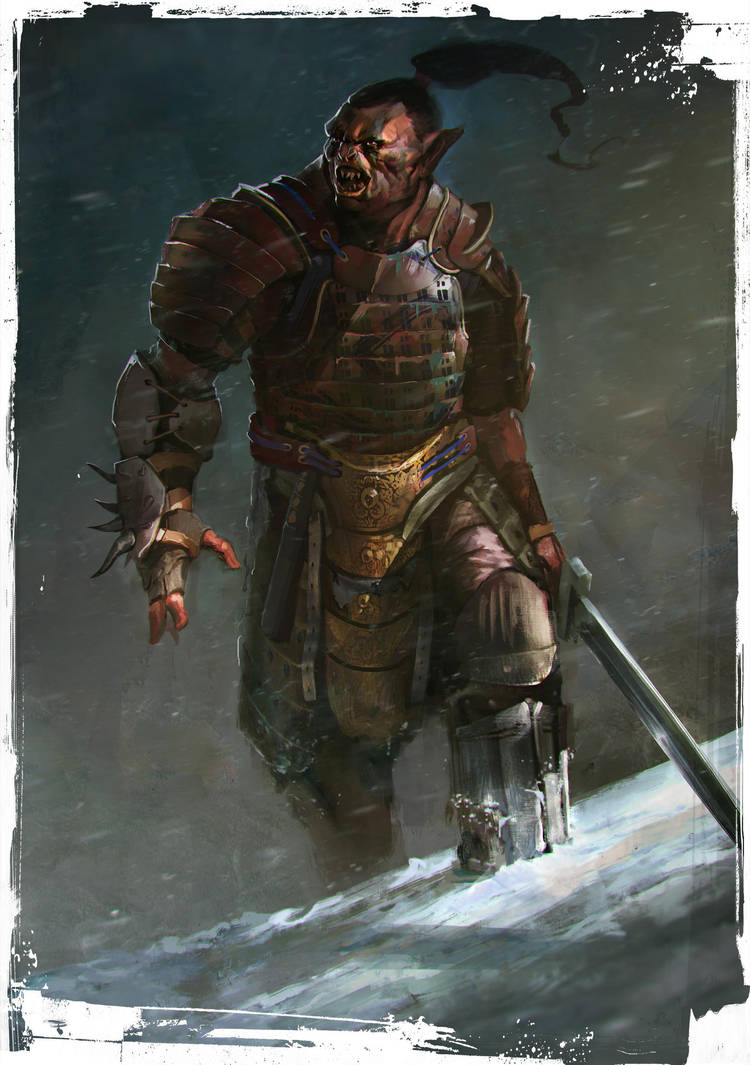 |
| Art by Alex Tzutzy |
They fought against the goblins, slaying them in their hundreds. The goblins watched them slaughter their kin, ambush their homes, outmanoeuvre their armies at every turn. They looked on with fear, rage, and awe.
When they finally managed to capture the humans, they did not slaughter them. They were instead brought before the goblin shamans, paraded through the war camps, stripped and prepared for the ritual.
Crowds parted as the bloodied pelts of the goblins they'd slaughtered were carried through the camp. One by one, they were bound and stitched to the screaming warriors. They would know fear and pain as the ritual started, and be devoid of it when the ritual ended.
When the men opened their eyes at last, they were men no more. Their skins were stained the colour of blood. Their features mangled under a goblinoid visage. They still had their wits, their minds, their military strategy and knowledge of the battlefield. But their allegiance was with the goblins now. It's in their blood, after all.
Just a small post for now, part of a series of me writing up some prompts I've given fellow D&D players on Discord. This one was in response to 'how should I do hobgoblins in my setting?'
Thursday, January 31, 2019
An Alternative Slaad
Ideas presented here are partially adapted from Goblin Punch's slaad post, especially in terms of colour-hierarchy.
Slaadi are the multiverse's antibodies against a universe of pure order, and they look like frogs. Both of these points are equally important.
Slaadi are drawn to sources of chaos and unpredictability. They are enraged by stagnation, order, and law. A slaad would get as equally angry over an evenly trimmed lawn as it would over a fully lawful realm. When they find a source of frustration, they seek to change it. They do not destroy it: destruction can come as a result of this change, but the object or person in question must remain in some form post-slaad intervention.
Sometimes the simplest way to change something- or someone- into a more tolerable, unpredictable state is by making the creature of interest into another slaad. Like frogs, slaadi lay jelly-like eggs, which turn into tadpoles and metamorphose into adults. Like non-frogs, slaadi inject their eggs into hosts through their ovipositor-like claws.
Slaadi are the multiverse's antibodies against a universe of pure order, and they look like frogs. Both of these points are equally important.
 |
| The true face of chaos. (photo from Philadelphia Zoo website) |
Sometimes the simplest way to change something- or someone- into a more tolerable, unpredictable state is by making the creature of interest into another slaad. Like frogs, slaadi lay jelly-like eggs, which turn into tadpoles and metamorphose into adults. Like non-frogs, slaadi inject their eggs into hosts through their ovipositor-like claws.
Saturday, January 5, 2019
An Alternative Kobold

Ribbons of meat falls from the dragon's flank, splattering to the ground in a grotesque cluster. The beast roars in pain and vengeance. Dragons are chaos and sin made manifest, and their whole being is driven by the desire to be mighty and powerful. Their still-warm flesh still holds this drive, and wills itself to continue the pursuit. Slowly and clumsily, the flesh begins to stir, slithering and dragging itself into piles. They wind around each other, grafting into shape.
Kobolds are flesh given thought. Scraps of offal and fatty layers filled with greed, wrath, and envy. One spends its first few hours of existence without bones. As the mass attempts to regenerate, energy is focused into the head, providing a maw to bite and teeth to pierce. The kobold has little need for other bones: all the better to wriggle through gaps and squirm into people's houses.
Subscribe to:
Posts (Atom)