"Nagpas can't learn from that which isn't destroyed. Imagine how bewildering and terrifying a city full of life must be to them. is it any wonder that they seek the ruin of such places?"
When Jim Henson designed the skeksis, he "became intrigued with the idea of a reptilian race assuming control over a formerly splendid past society." This eventually turned into the greedy, prideful, pathetically terrifying skeksis, which in turn likely went on to inspire the design of D&D's nagpa one year after the movie's release. With their latest incarnation featured in Mordenkainen's Tome of Foes, here's my take on their lore and mindset.
The nagpas were once a cabal of mages that sought to siphon power from the gods. As punishment for their greed and treachery against those that first gave them their power, they were cursed with vulture-like forms, blackened bones, and the inability to obtain knowledge from that which is not destroyed or discarded.

Nagpas crave power above all else. Their greed caused their curse and they have learned little from this. The added complication of only being able to learn from the remnants of fallen civilisations is but one more challenge in their way. As they gain more power and knowledge, not all of it can be fully recalled. As a result, the nagpa constantly feel they are on the path to gaining power, never truly obtaining it. The satisfaction of a victory will last a week at most.
To accumulate new knowledge, nagpas must reduce modern civilisations to ruin. They then pick apart the remains for scraps of information, interrogating the broken spirits and communing with the corrupted land. Nagpa can of course wait for societies to fall on their own- they are long lived, made to endure their punishment as long as possible- but their patience is not infinite. Their time must be occupied, and plotting machinations to destroy a civilisation is certainly one way to pass the time and focus the mind.
The typical method of their plans is to manipulate others into bringing about ruin on their behalf. This allows the nagpa to keep to the shadows and observe from afar, providing nudges in the right direction towards the downfall of their desired target. Nagpas know how to use their words to hide their inability to comprehend those around them. They give the targets of their manipulations pet names, refer to places in broad strokes ("the capital", "your home", "the land of the enemy"). They take the role of the kindly old hermit, the crazed wizard, the disfigured advisor.
Slowly and steadily, they seed ideas into the minds of those they lure, turning them against the sources of stability and power in their societies. Druids are led to blight the crops, rogues to assassinate their leaders, clerics to defile their temples and invoke the wrath of their gods. Plans that turn those that cursed them into tools greatly please the nagpa.
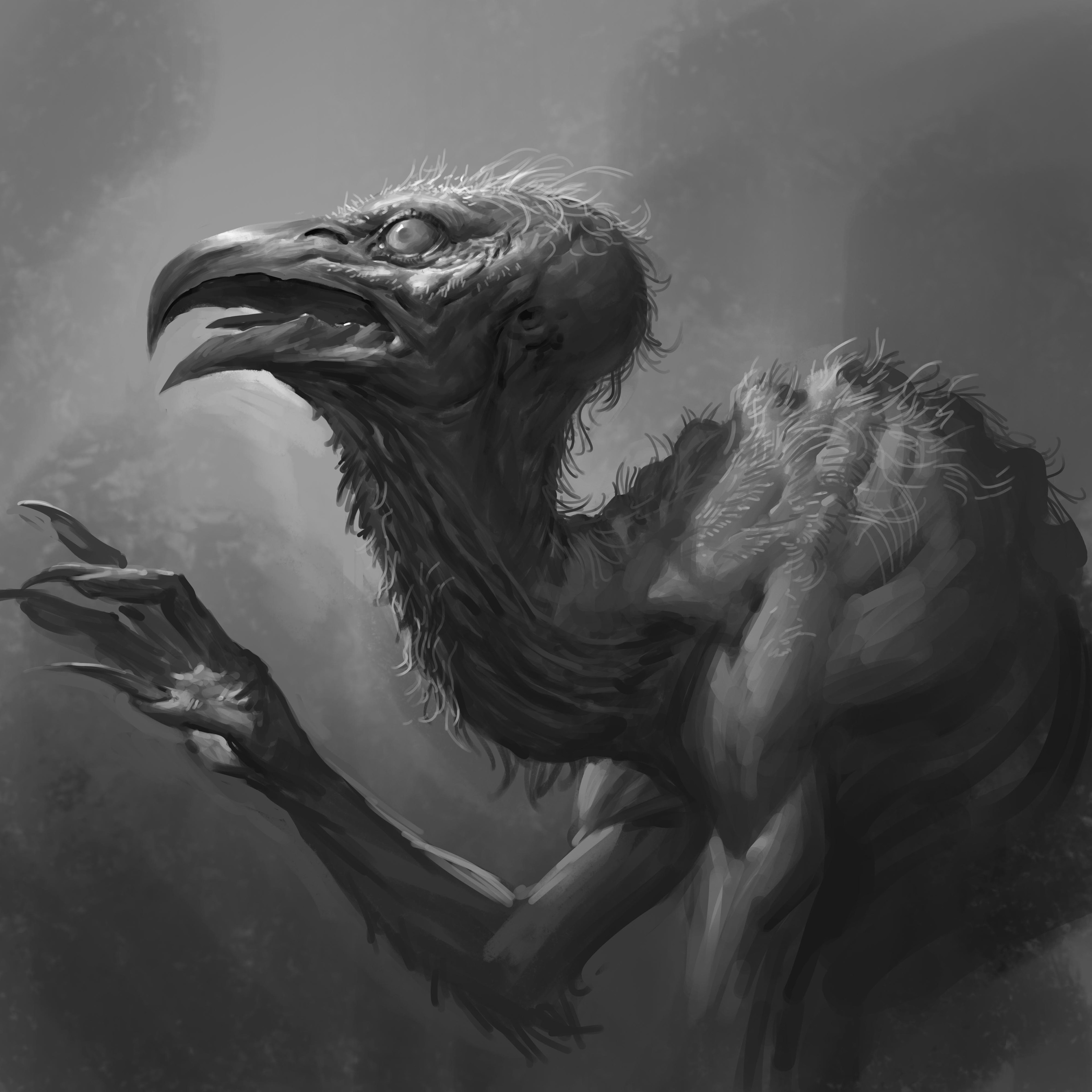  |
| top: Daily Sketch by Johan Grenier bottom: Skeksis Portrait by Laura Auwercx |
A Nagpa's grimoire contains ancient spells. Any spell with a name in front of it (e.g. Melf's acid arrow, Tasha's hideous laughter) is unknown to them. Their spells focus on unravelling knowledge, finding sources of knowledge, and pulling that knowledge from what few sources they can. Legend lore, geas, and speak with dead are a must. Any arcane research they had been studying prior to their transformation has been abandoned, as their primary focus now is on regaining the power they constantly feel they have lost.
Nagpa minions are old and repeatedly used. They'd rather summon the same fiend time after time than try new ones. Constructs are also unlikely to be heard of, but if one is obtained then it will be fussed over constantly, studied as it is damaged, unfolding into its own manual on creating more of them. Some choose to farm their own minions, rearing colonies or setting timeless slaves (such as skeletons) into an automatic factory of making servants*. Over time, a nagpa may become content in this production line and forget where its minions come from, assuming they appear from thin air, or that they keep using the same individuals time and time again.
*I recommend chuul. No specific reason.
The Naga is in Mordenkainen's Tome of Foes, pg 215

No comments:
Post a Comment