Saturday, October 5, 2019

What's in a Name?: a Response to UA Onomancy Wizard

Fear Names.
Names have power in identity.
Others can use names as weapons.
Names are a hook that can be used to track you...
Remain nameless, and you shall be safe.
~ Planescape: Torment

Multiple D&D subclasses inform the DM about aspects of their world. A cleric's domain informs what deities or forces are present in the world, as does a warlock's patronage. The presence of glamour bards informs one of the many roles of fey in the world, and draconic ancestry sorcerers inform the potential for bloodlines of humanoids and dragons to intertwine.

This list has been further added to with the most recent UA's addition of the School of Onomancy, a wizard subclass that focuses on the role and control of true names. Their flavour text states:
Something that is named stands out in the multiverse, distinct from the tapestry of creation all around it. That distinction creates power that onomancers seek to tap.
True names - the concept that knowing an individual's name gives you power over them - are found throughout fiction. From the fairytale of Rumpelstiltskin to the multiple applications of true names in White Wolf's World of Darkness games, to the banishment of DC Comics's Mr Mxyzptlk, the power of names comes in many forms and with many depictions. Dungeons and Dragons has used it multiple times in the past, but this has declined since 3rd edition. In 5th edition published content, the arcane usage of true names is mostly limited to flavour text; the most it can be seen mechanically is with devil summoning:
A mortal who learns a devil's true name can use powerful summoning magic to call the devil from the Nine Hells and bind it into service (MM, pg 67)
On each of your turns, you can try to issue a verbal command to the devil (no action required by you). It obeys the command if the likely outcome is in accordance with its desires, especially if the result would draw you toward evil. Otherwise, you must make a Charisma (Deception, Intimidation, or Persuasion) check contested by its Wisdom (Insight) check. You make the check with advantage if you say the devil’s true name. (Infernal calling spell)
Personally, I love the idea of true names. It's an evocative concept that has made its way into multiple forms of fiction, and creates great opportunities for interesting adventures and roleplay. If players want to defeat a powerful enemy, they can go out of their way to seek the villain's true name, learning about their history and the choices they made to get to where they are, then use this knowledge to compel the villain to surrender or change their ways. It also flows in well with the general idea that words and magic are intermingled, as with bards and their songs, paladins and the oaths they swear, and the words of power within the D&D spell list.

I fully support the presence of true names in D&D, and that's why I cannot say I'm the biggest fan of the onomancy wizard.

Sunday, September 22, 2019

How a Dwarf is Made

Updated on 24/09/2019 to add more depth. Thank you to my readers for getting me to do more with this; I appreciate it when people show interest in my ideas, and when they're willing to tell me that these ideas need to be worked on.

Dwarves are not born; they're made. When a dwarf wants to make a child, they collect materials and begin their project. For some it takes months, others years to get their child together. Some dwarves find themselves overcome by a desire to construct new life - a moment of flash brilliance, akin to a eureka moment. Whilst this may be directed into other constructive pursuits, the potential to make children is always there.

The materials shape the dwarf, but the exact specifics of how are unknown. A mixture of geology and physiognomy is sought to inform the parents of what is best used for their child. The most common material is clay; easy to work with and mold, good for creating a sense of character. Others may be made of soapstone or alabaster. Dwarves with a marble birth are seen in many cultures as being of higher stock, as marble cannot be reworked once carved, meaning they were made with skilled hands and a great deal of preparation.

With no bloodlines to speak of, families and clans are defined by what materials they were made from, where those materials were collected from, and who brought them into the living world. Family relations and proximity can be defined by impurities in the building materials. Whilst an adult dwarf is for all intents and purposes made of flesh, elements of their rock-form still remain in their appearance. Parents are defined by those that crafted their body and whispered the words of life to them. This means a dwarf could have only one parent, or could have half a dozen.

Each child is unique, each one perfect and flawed in its own ways. Baby dwarves look more like golems than adults; as they age they come to resemble living things more and more. During their development they are malleable, both in mind and in body. Strict parents may threaten their children with being returned to the kiln for further work.

When they are created, they are traditionally given time to set, both physically and spiritually. This is time for the earth to find them and know their presence, and for the spirit of the child to find its way into its new body. Once this time comes to an end, the parent(s) hold their child close, whisper their name to them, and give them life.

Of course, time has taken its toll and changed the ways children come into being. Midwives can be commissioned to sculpt a child on one's behalf, or to at least take a more prominent role in smoothing out features and cleaning up the model before life is given. Households may hire the same sculptor time and time again, each with their own signature style of craftsmanship. The discovery of golemancy and the making of constructs has caused cracks in dwarven culture, with some seeing them as a human would see a newly-discovered primate, whilst others see them with the same sense of looming fear as modern man sees a robot/A.I. takeover.

Industrial creation is always an option, though many would claim the children made in the same casts and forges lack the same depth of character, the same intricacies of personhood. There is little to make them unique, no caring touch of a parent, no nurturing loved one to hold their cold body close and bring them into the waking world. In some communities, bringing new dwarves into being is overseen by a committee to ensure the construction is reasonable and follows the community's values.

In rare cases, dwarves may seek to create child clones of themselves. Whilst this is possible - reports do speak of entire clone colonies made to explore new caverns and set up duplicate settlements - the process of creation does not absolutely determine the individual's personality, only their external form.

Myths speak of the dwarves being crafted into being, then being taught how to make more of their own kind. Many more tales of old speak of heroes made from polished marble, tragic heroes covered in deep crack-like scars, and the construction of sentient prosthetic limbs crafted after losing limbs in battle.

Thursday, September 19, 2019

Consider the Sahuagin

Deciding how I want to do sahuagin - or shark-people in general for non-D&D settings - has been difficult, mostly because I haven't wanted to categorise them as inherently 'evil', but at the same time want to evoke the feelings of the official sahuagin and address the elements one would expect from a society of mutant hexapodal shark-men. Here's where I'm up to so far.

character concept by Giorgio Baroni
Sahuagin are predators at heart, and are fully aware of it. They haven't succumbed to bestial fury, but have instead built a culture around their instincts to hunt.

Their connection to sharks is one akin to man's first relations with wolves; not full domestication, but not outright hostility. There is a mutual recognition of kinship and respect, and the sharkfolk have over time developed the ability to manipulate sharks and their relatives to aid them in their hunts, or shoal in designated waters.

Different sharks are chosen for different purposes and regions. Tiger and lemon sharks aid in pack hunting; many a diver has been caught off guard by how tactical a sahuagin hunting pack can be. Hammerhead groups of ~100 individuals guard treasure and lairs, whilst white sharks are bargained with by leaders as guards and enforcers. A few tales speak of gargantuan, ancient sharks being called allies of the sahuagin, with the beasts coming and going for decades at a time, depending on what suits their fancy.

Sunday, September 15, 2019

Tolkien's Dragon-Spell

The Glance of Glaurung by Alexey Rudikov
In Middle Earth, dragons have an ability known as the dragon-spell. This is essentially described as a kind of hypnotic voice/gaze, allowing them to manipulate humans and elves to their will. Dragon-spell could create feelings of distrust, influence the target's perception of the truth (as with Smaug), and even lead to total memory loss and madness (as with Glaurung).

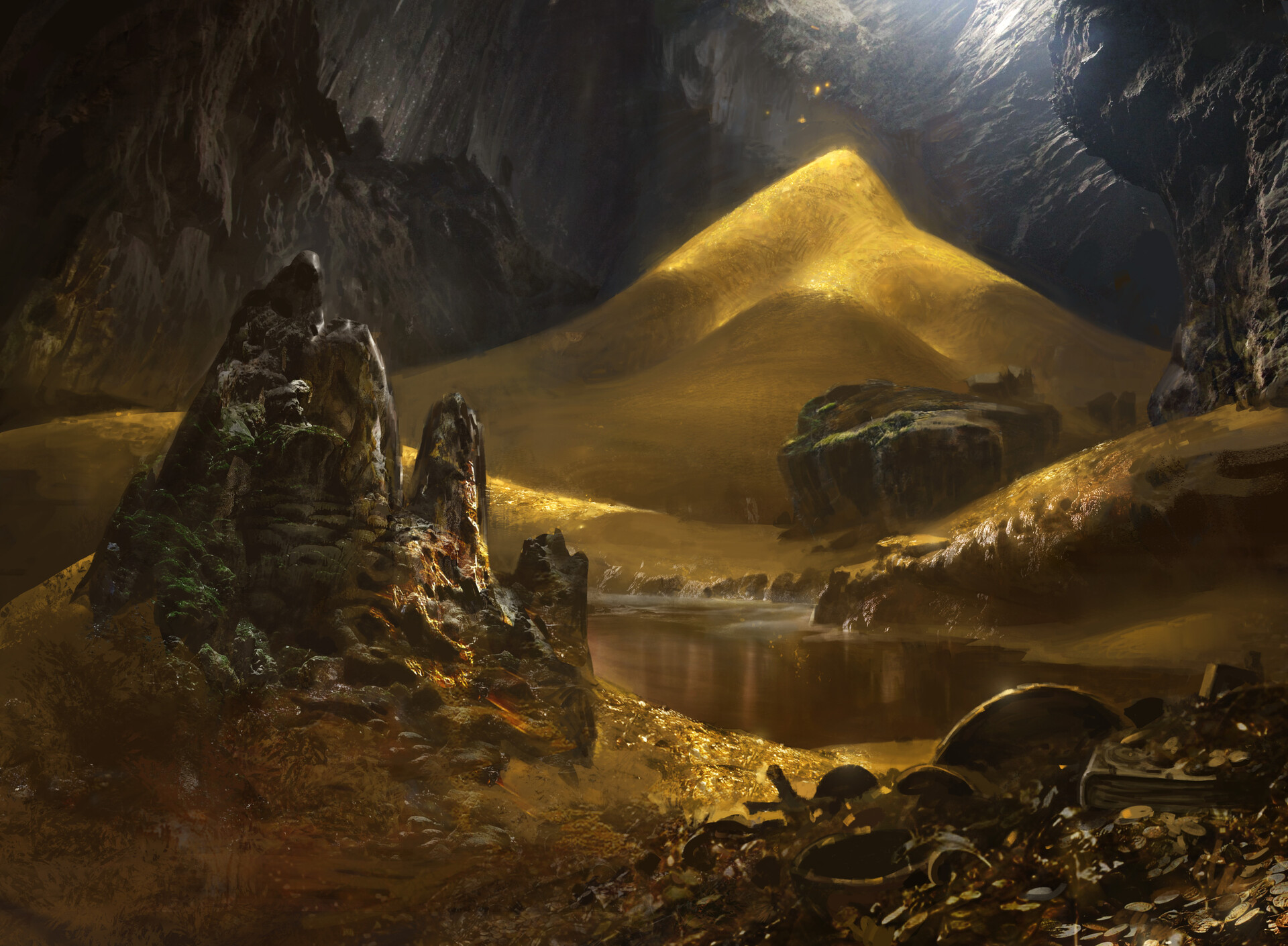
This ability has been connected to dragon-sickness, in which individuals exposed to a dragon's hoard (especially after the dragon's death) can be overcome with greed.

Further information on these can be found at A Tolkienist Perspective and the Lord of the Rings Fandom Wiki.

I wanted to have a go at making these traits into mechanics that could be used for dragons in tabletop games, using D&D 5e mechanics for this entry with the knowledge that they could then be converted into other systems as and when needed.

Sacrifice to the Green Dragon by John Tedrick

Dragon-Spell

Dragons with this capability gain the following additional traits:

Roving Eyes. The dragon targets one creature within 120 feet that can see the dragon's eyes. The target must make a Wisdom saving throw or be charmed by the dragon. At the end of each hour, the target can repeat the saving throw, ending the effect on a success. On a successful save, the target is immune to this dragon's Roving Eyes for 24 hours.

Serpent's Tongue. if the creature can understand the dragon, it must make a Charisma saving throw or become influenced by the dragon indefinitely. A creature that cannot understand the dragon is unaffected by this ability. Before the saving throw is made, the dragon chooses one of the following effects to apply to the creature if it fails the saving throw:

False Truths. The dragon manipulates the target's perception of the truth, creating feelings of greed, loyalty, distrust, or any other desired mindset.
Memory Loss. The dragon clouds the target's memories, causing partial or total memory loss. The dragon can only remove memories in broad strokes (e.g. "your childhood" or "your time in the castle").

The effect can be ended early by the dragon speaking a command word as a bonus action, or by a remove curse, greater restoration, wish spell or similar ability.

Dragon Sickness

This counts as a curse that starts when a dragon dies. Within 1d4 hours, the hoard becomes infested with the curse. Any creature that comes within 30 feet of the hoard must make a Wisdom saving throw. On a failed save, the creature is afflicted with dragon sickness. On a successful save, the creature is immune to this hoard's dragon sickness for 24 hours. A creature with dragon sickness gains indefinite madness (DMG, pg 258-260), adding the following flaw to their character: 

"protecting the hoard is all that matters to me now."

The character puts the hoard above all else, and the hoard intends to keep things that way. At the DM's discretion, a particularly large hoard may also provide the following effects to a cursed individual:
- They only eat and drink half as much as a regular person, and sleep half as long
- They are immune to disease
- They have advantage on saving throws against being charmed or frightened
- They age at 1/3 of the rate of their normal race

Dragon Sickness can be cured as with any other indefinite madness. At the DM's discretion, a character may also be able to repeat the saving throw after an extended period of time away from the hoard, or if their desire to protect the hoard conflicts drastically with their character bond (such as with the case of Thorin choosing between the hoard and aiding his allies in battle). Should additional effects be used, the target returns to their own mind with 1d4 levels of exhaustion (no more than 4 total) and their age catches up to them.

Dragon's Hoard by Adam Paquette
I would potentially consider also adding this effect to magic items within the hoard as a curse, similar to the effect on items stolen from the lairs of Mummy Lords (MM, pg 229). Straight up taking the specific regional effect would also work fine.

I also feel that these abilities would work well together with the 'words of power' used by dragons in Skyrim; perhaps instead of traditional breath weapons, they use effects similar to power word stun, power word pain, or power word kill?

Sunday, September 8, 2019

Reintroducing Alignment

I wanted to get some vague ideas down on how alignment could be made into a more integral part of 5e, either in general or for a specific setting or campaign. Many of these suggestions are mechanical and come down to the same root point of having alignment be more mechanically present than it is currently, but there are a few lore suggestions here and there as well.

Unfortunately this post is going to be a bit disorganised, though that's nothing new here.

It's also worth mentioning that this isn't a post on why alignment should be implemented, merely how.


To start off, I'm going to give definitions of alignment. The notion of what is or isn't under which alignment is flexible and open to interpretation, but for this post I'm going to steal and tweak my definitions from a previous post I made on alignment-based factions:

Good: acting for the benefit of others, especially when no personal gain is achieved from it. Altruism, compassion, and empathy are tenants of Good.

Evil: allow or enforce suffering upon others, for one's own benefit or for no benefit whatsoever. Selfishness, manipulation, and abuse are tenants of Evil.

Law: adhere to and enforce a set structure to life and society. This could be a city's laws, a factions rules, a deity's oaths etc.

Chaos: promote free will and metamorphosis, opposing control and restriction, and abiding by one's own sense of how to behave.

Alignment for characters has a dominant trait and a recessive trait, as shown with capitalisation. This is used to indicate which of the two alignments - law-chaos and good-evil - overrides the other in decision making. For example, a Lawful good character will choose Law over Good if pushed, whilst a lawful Good character would choose Good over Law.

Unaligned creatures are such because they lack an understanding of the alignment system and as such are unaffected by its influence. Whilst an animal may act in a chaotic neutral manner, it does so because of its instinctual drives, not due to a sense that the alternative is morally wrong or unfavourable. Creatures with completely different senses of morality and alignment are also classified as Unaligned - in my books, this should arguably include oozes and aberrations, given that their minds are so alien to ours that they may not work on the same notions that we do. They are outside of alignment.


A game that brings back alignment as a prominent aspect should bring it to the front mechanically as well as in theme and lore. D&D does do this, but 5th edition does so significantly less than past editions. We mainly see alignment present in these aspects:

Spells: spirit guardians has its damage type vary on character alignment. This kind of thing should be expanded upon. Different character alignments or deity alignments should influence damage types, or potentially further influence spell effects. Perhaps casting burning hands whilst Chaotic in alignment makes more things ignite on contact, or bless and bane could be the same spell, with the effect changing based on whether you're Good or Evil?

Monsters: There are some monsters that have alignment-based abilities. Sprites can detect alignment using their Heart Sight; rakshasas are vulnerable to piercing damage from good-aligned creatures; demiliches and unicorns have lair traits/regional effects that affect non-evil and good creatures respectively. Planar creatures especially show these traits, which is to be expected given their stronger connections to alignment.

Items: Items show some of the more prominent alignment mechanics in the game, with items that can only be attuned to if you are of a specific alignment. This makes sense to include, or potentially to expand upon: perhaps an Evil artifact can be attuned to by a Good person, but the abilities they get are different. Alternatively, maybe their abilities are warped? A Good cleric attunes to the Evil item and now all of her healing spells instead deal necrotic damage, or only give temporary hit points?


As a vague idea, why not have the forces of alignment be more conventional large-scale forces, like deities? We have dichotomous notions of deities in real world religions (e.g. Abrahamic God and Satan), and Forgotten Realms already has the alignments act as planar forces, so why not have gods of Good, Evil, Law, and Chaos? These could in turn create the gods of dual alignments, and/or create emissaries to spread their influence - the devils, slaadi, celestials, modrons etc.

With my personal prefernce for Chaos and Law, I'd potentially go for a god/entity of each of these, which in turn have six opposing spawn (for Chaotic and Lawful good, evil, and neutral).

Alternatively, why not go the route of Avatar? Each alignment is an ideology and way of life, none perfect on their own but best seen in their interactions with one another and the balance of the four. In such a setting, Neutral may be seen as the ideal state to be in, with players traveling the land to learn about the different ways of life and their influences on the world. This could also be an interesting way of exploring how different alignments look from outside perspectives, and how they can come across in many different forms.

An important idea in such a setting to get across for me is that the prescriptive nature of character alignment is something special - it is an indication of free will and the ability to make choices. It is this that differentiates them from celestials and fiends, and this that links them to giants, dragons, and other such creatures. Whilst they may lean towards certain alignments, this isn't set in stone.

This is in contrast with extraplanar entities that directly serve the ideals of their alignment. Their alignment is a fixed state, a constant (yes, even the Chaotic entities) mindset that is unwavering. It can be confused, misled, possibly even manipulated, but their actions and personality are inherently shaped by what they are. Unlike players and other such entities, where alignment is prescriptive, these entities have descriptive alignment.


Alignment Thresholds
Alignment is on a scale for a reason. There are degrees to which an individual shows alignment, and having thresholds is one way that players can quantify how Good or Lawful their character is.

This is akin to Ravnica's Renown rules, where completing certain actions increases your level of influence and benefits within a faction. It could also be compared to the Humanity and Path tables in Vampire, where committing certain acts influences your behaviour and abilities.

The DM would have a table for each alignment. On these tables are actions and modifiers - actions such as harming an innocent, forcing an ally to face the force of justice, starting a rebellion or putting yourself in harm's way to save another. When players commit an action, the DM can alter the number of points they have on the alignment axis. You need a minimum number of points to be classified as an alignment; under this you count as Neutral.

Upon reaching certain point thresholds, different boons become available to you. These range from being more amiable with creatures of the same alignment to actual abilities based on the tenants of your alignment. They should ideally be beneficial to both martial and spellcasting classes, and have some flavour based on your alignment of choice. Perhaps there could be multiple to choose from, depending on how detailed this system was.

EDIT: After some discussion, these boons should ideally be focused on non-combat aspects of the game to prevent players going specific alignments just for certain attacks or combat benefits.

If you drop below your alignment threshold, the boons you had beyond your new score are lost to you.

These boons may also be available to NPCs, giving nice flavourful mechanics to your allies and enemies, and also informing players about what kind of person or creature you're dealing with.

Running Ten Candles online: a reflection

These things are true.
The world is dark.
And we are alive.


I am very happy to report that last night I had a successful first time running Ten Candles, a tragic horror one-shot TTRPG written by Stephen Dewey and published by Cavalry Games. In this game, players collaboratively tell the tale of a group of survivors, attempting to do one last act of defiance against the enemy (Them) that will slowly and surely consume them in the darkness. It is very much intended to be a game played in person, with much of the game’s mechanics being linked to the visual display of the game, as ten candles are lit in a circle and each player literally burns their trait cards one by one as they are used up.

I don’t currently have ten candles, a fireproof bowl, or a group of people with time to run this game. I also didn’t want to embarrass myself in front of people by discovering halfway through a game that I can’t do horror very well. With that in mind, I had to improvise, running the game online through Discord and Roll20.

Below isn’t necessarily a full review of the game itself, but instead a reflection on how it went running the game on a digital platform, and what lessons from this session could be brought into future games both on and off the computer.

Sunday, September 1, 2019

Faction Prompt: Gorgon Templars


I was sent this post recently, and having both a soft spot for bullet point worldbuilding and gorgons, I wanted to have a go at expanding on this concept a bit.

The tale of Saint Orabella is one of martyrdom and monsters: her homeland decayed under the weight of their corpulence and corruption. Distraught at what she saw, Orabella prayed to take on the sins of her people so that they may be given a chance to start anew and redeem themselves. In doing so, she was transformed into a gorgon, and her church cast her out as a monster. Orabella held onto her faith for the rest of her life, until another saint slew her as part of their journey.

Knights that seek to emulate Saint Orabella - to take on the burdens and sins of those around them, to endure deformity and exile for their faith and the betterment of others - may find themselves entering her sect. Entering her cathedral, they are watched by stone sentries, their faces wrought with looks of defiance, endurance, and exhaustion. The cathedral's interior is plain. At the far end, an altar awaits its worshipers; held atop in the caring hands of a headless statue is a relic, covered in a thin veil of silk.

The severed head of Orabella.

Medusa Head by Shafiq Cromwell
Initiation into the Sect of Saint Orabella requires each knight to gaze into the eyes of their saint and endure her stare. To the knights, petrification and the power it brings is as much a symbol as a real affliction. For them, it is a physical representative of the burdens one has to bear and the temptations one must resist in order to be a good person. Those that are petrified give in to these temptations and cannot carry their burdens, whilst those that endure are able to push them back... for a while. In time, they too shall fall victim to the curse and join their brothers and sisters as stone guardians of the cathedral.

Exactly why this happens has been interpreted in many ways. Some argue that temptation is not something that can be resisted forever by mere mortals, and the petrification takes its hold over all because they are simply human (or whatever other species they may be). Others claim that the 'blessing' of their saint is simply a curse given by a monster, and that the knights are clearly deluded for seeking power from a monster's affliction.

The knights bear their marks with subtlety at first. Their eyes look weary, sometimes reddened and weeping. Their joints ache and muscles tense without provocation. Though their skin may be clean and youthful from the constant use of healing salves, the smell of alchemical ingredients clings to their body, and over application may stain their skin in time. It is this staining and reliance on alchemists that has led to this sect being ousted in the past; few alchemists are willing to withhold details of their clients when a templar inquisition is at their doorstep.

The excommunication and imprisonment of these knights has been kept a close secret, for knowledge of splintering within the templars - or that this splintering was due to the praise of a saint turned monster - would do little to aid their efforts in maintaining control and praise of the common folk. Justifying bloodshed and raiding in the name of their lord is hard enough without including severed heads and petrification into the mix.