Monday, April 15, 2019

Consider the Fomorian

I've been a bit AWOL recently after a rather productive spurt. I shall be trying to get back into the swing of things soon! To start things off, let's have a look at one of D&D's monsters that come from Irish mythology...

No one is entirely sure where the fomorians got their curse from. Some say it was archfey that forced them to show their internal ugliness on the outside. Others believe it was the gods, for the fomorians themselves give praise to no higher or lower powers. Perhaps they were once gods themselves, cast down by other divines for their cruelty. Mages speculate their attempts at fully mastering magic backfired, or that they are the result of exposure to arcane fallout.

The fomorian curse is focused on the malice and cruelty in their hearts. The more wicked a fomorian's thoughts and intent, the more disfigured their bodies become. This results in an almost neverending spiral, as the uglier the fomorian becomes, the more spiteful and self-loathing it feels.

No two fomorians turn out entirely the same. Some are covered in warts and monstrous growths; others have vestigial twins embedded in their flesh; some look angelic but reek like cesspits and speak like scraping metal sheets.

The Fomors by John Duncan

Saturday, April 6, 2019

Reptilian Campaign

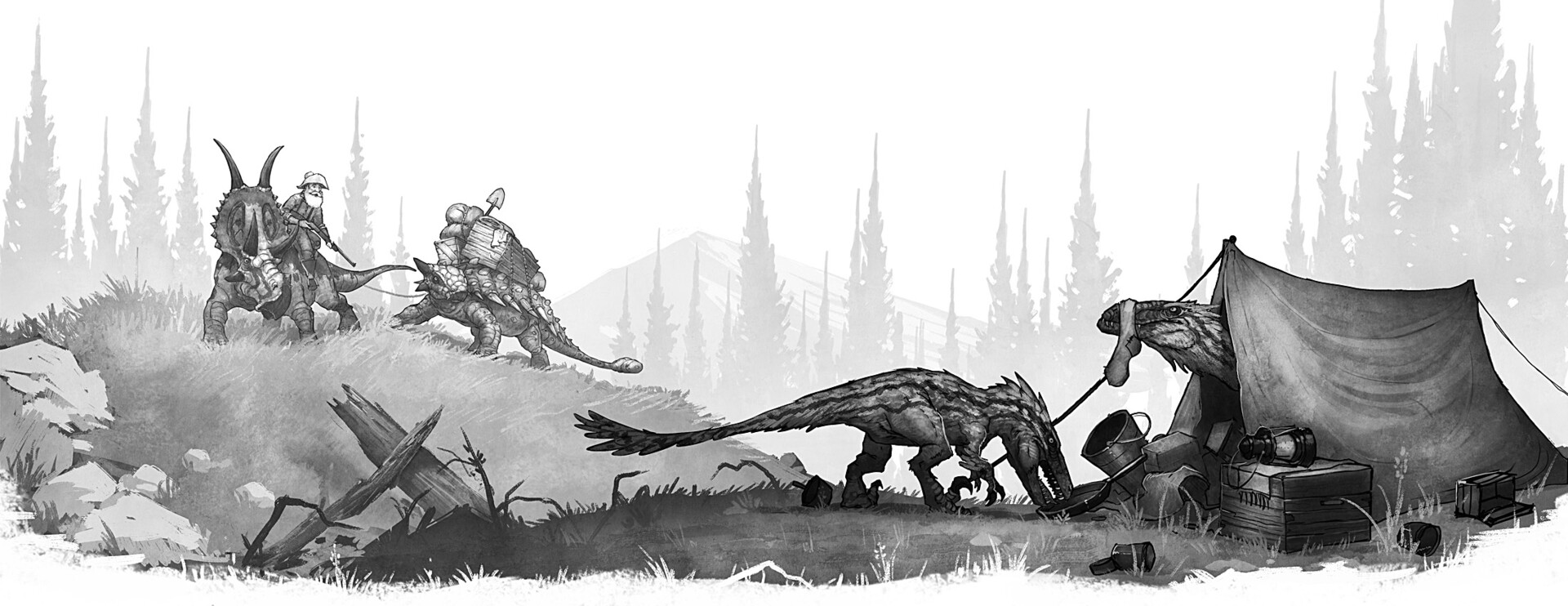
A friend of mine recently proposed running a campaign based on Dinosaurs of the Wild West by Shaun Keenan.

Image from Shaun Keenan's ArtsStation.
I chatted with him about potential ways that the idea could be used, which in turn led to him making the following (abbreviated) setting premise:

Long ago, the divine pantheon split into those that would strike out against the devils and those that would not. The warring gods were victorious, but in doing so disrupted the power struggle between devils and demons, resulting in demons breaching the surface world. To destroy them, the gods that had avoided hell used much of their power to banish the fiends back to their pits and lock their more violent brothers away, turning them into the new archdevils. This war caused mass arcane fallout, making a world where those with thicker skins (figuratively and literally) could endure moreso than others. This is the age of reptile supremacy.
Whilst it does detract from the simplicity that was dinosaurs in the Wild West, I ran with the ideas a bit further to see how players would actually interact with these concepts in a way that their characters would know and understand. Here are a few ideas that I'm especially happy with.


Gods & Devils

I am under the assumption that my friend was planning to either use or heavily be inspired by the Forgotten Realms pantheon, with Tyr as the god that headed the fight against the archdevils. With this in mind, the trapped gods are now the new archdevils. From this, you gain two pantheons; the pantheon of Old Gods that ended the great war but are now drained of power, and the pantheon of Fell Gods that have increased power but at terrible cost. The new archdevils take their duty- fighting the demons- seriously, and only they truly know whether they feel remorse for the position they now find themselves in.

All sacred animals and relevant symbols are of course replaced with dinosaurs and other large reptiles.


Tiefling Martyrdom

The first tieflings could mostly be paladins & clerics of the old gods, meaning tieflings (at least some of them) could be a very religious/zealous lot, seeing their makers as martyrs instead of evil entities. It could be a strange surprise for people to see these infernal humanoids practicing the same faiths they do, just as pious and humble as those around them. They know their forefathers fell from divinity out of their belief that they could make the world safer, and they still hope that if their gods can break free of the prison, they can continue their good work and fix the mess that the material plane now is.


Skull Collector by Raph Lomotan

Mammalian Underdark


Deep beneath the earth, the underworld houses an echo of what the world could be now; one without dinosaurs and reptilian overlords. It is a cold, harsh place, dwelled in by strange mammalian goliaths: cave mammoths, echolocating terror birds, pale smilodons. Hidden in small communities, shamanistic neanderthals hide from the cavern beasts and praise the remnants of the god war that have fallen through the cracks of the earth.

I pitched this idea to myself as an underground ice age. Imagine traveling through caverns and tunnels with low light and food, but everything is cold, covered in thick snow or slippery ice, and there are sabre-tooth cats lurking around the corner.


Watcher of the Ancients by Bjarke Pedersen

Giant skeletons

In my friend's original idea, the remaining gods that fought the demons used an army of giants and dragons to fight them. Whilst some dragons survived to help introduce the age of cold blood, the giants fell in battle.

Their skeletons litter the land, ripe for taking by those skilled with necromancy. In this land, 'undead' does not invoke memories of shambling hordes, but of gargantuan striding beasts that rise from the sands, called to new wars beyond the grave.

I am reminded of the Japanese gashadokuro: giant, invisible, vampiric skeletons.


Bound devils

People make pacts with weakened devils, binding them to objects to access their power. Some call them artificers, but others know the real truth. How else do their crossbows shoot hellfire bolts, or their cloaks shrug off damage and reveal a winged, horned shadow standing behind them at all times? What is devil worship but another kind of prayer? Can any of the believers in the weakened gods above claim to have communed with their lords face to face, to have shook their hand and left with blessings?


I'd also highly recommend checking out Goblin Punch's mutant dinosaur generator, as well as their dinosaur cleric. It's a cool idea that could be fun to play with.

These ideas definitely aren't the most directly related to Wild West Dinosaurs, which is possibly why I like them- they can be used for other things outside of the initial premise.

Sunday, March 17, 2019

The Industry of Death

Underworld by Dragos Jineau
(based on an idea of duergar being dwarves that dug too far down into the earth, breaking into the underworld and being claimed by death's domain. Also heavily influenced by listening to Hadestown a lot recently.)

Death's job used to be easy. Few things died in the old days, and the passage of those souls was a short duration. Many of the first children of the gods were made without an end of life in mind. For Death, existence was simple.

Then the mortals turned up.

A mortal soul lasts longer post-mortem than that of a worm or tree. Throughout life their soul accumulates debris- quirks, habits, tastes, personality, uniqueness. This keeps it tethered to its last life, and makes their souls restless.

To solve this, Death gave the souls purpose. Death gave the souls work to be done.

The underworld is an expansive factory of subterranean bridges and workhouses. Oil, steam, and work are the currency of this land, where the restless dead toil away at the Great Machine.

The Great Machine has many components, many functions, many forms. If asked, no one knows what the true purpose or end goal of the Great Machine is, only that it will eventually be done and that it will be done sooner if they work harder. The passages of the underworld echo with the work chants of the dead, all focused on the continuation of the Great Machine.

Those that enter the underworld come to find it technologically more advanced than the surface world. Thousands of souls all working towards one goal have achieved much through plundering the earth's core resources and putting them to work. Adventurers may seek to bring these technologies to the land of the living, but Death guards them fiercely.

Death has few guards in the underworld. There are wardens that ensure the work is done and that the workers do as they're told, but few warriors. Instead, adventurers face the opposition of Death themselves. Death chooses the slain and cannot themselves die- few require this to be explained to them before they realise the fight is already lost.

Thursday, March 14, 2019

Faction Prompt: the Dreambreakers

A bit of a shorter post today- just want to get ideas down onto a page so I can work on them later when I have more mental energy.

Beholder dreams warp reality. To dream of another beholder creates more beholders; to dream of blood loss creates a death kiss. Many have speculated as to where beholders go in their slumber, by what power they can bring new life into reality, and whether this power is solely limited to a beholder-like manifestation.

Enter the Dreambreakers*.

Mages and psychics. All working to decode the psyche of beholders, to access their dreams and probe them in the desired direction.

Their large scale methodology is simulations. Sometimes simulations within simulations. Interacting with the beholder's subconscious, interpreting the characters and setting to gain further insight and access. There they travel as shades of their past selves, warped by the beholder's madness and subconscious influence.

The Dreambreakers of course must have beholders to indulge their research, and precautions against their physical forms being destroyed by whatever entities the beholder dreams up. Some choose to infiltrate beholder cults and organisations, acting as servants to get close to their aberrant masters. Others hire adventurers to incapacitate beholderkin, or to find weakened and diseased individuals that can be easier to exploit.

Conflicts are frequent. Different people interpreting dream aspects often results in mixed views. This conflict and tension ripples through into the dreams, which in turn shape the dream itself. Little is truly hidden within the dreams of the beholder.

As the members enter the dreams, they too may be dreamt into existence. These copies are mostly the same. They hate their originals, and will seek their immediate destruction. The Dreambreakers are aware of this- they all have their own copies to hide from, small gangs of not-entirely-themselves that seek their deaths. They also have experience encountering (but not stopping) the other entities their experiments bring into the physical world.

*Dreambreaker is a sucky name and I need to come up with a better one if I ever intend to use this in an actual game presented to players I respect.

Sunday, March 3, 2019

Consider the D&D Frogs

Dunno why the jumping one has a rack, but finding wide bullywug pics is hard.

Frogs in D&D worlds get a bad reputation. This is little surprise when one considers that so many unpleasant species - froghemoths, slaad, bullywugs, grung, and banderhobbs - have amphibian forms and origins. I wanted to have a go at adding some details to the last three on that list, connecting them together and giving them some differentiation from my takes on other low-level enemies, such as kobolds and orcs.

Bullywugs


These are the bread and butter of frogfolk. Grung and banderhobbs are merely variations or developments of the original bullywug template. They are 4-5 feet in height (females are larger than males), varying in mottled tones of green, grey, and brown. They sense the world primarily through sight, but in the water their sense of taste and touch is amplified; the water becomes akin to an extension of their skin.

Bullywugs live in wet environments out of necessity. Their skin must be regularly moistened to enable them to breathe properly. This puts a limit on their range and resources, but has made them masters of this domain (at least until something more powerful comes along). Bullywugs that engage in trips outside of their wet domains have found various ways of dealing with their water dependency- carrying multiple waterskins, sticking to riverine communities, or forming pacts with water elementals are just a few options available.

Bullywug technology consists of animal usage and repurposing of natural resources. Food is gathered through wormeries and fisheries, or hunted with spears and nets (food is consumed whole- frogfolk cannot chew). Their clothes are purely practical, made of reeds and grasses and shells. Armour is harvested from oyster reefs, weapons from animal teeth and bones.

Tuesday, February 26, 2019

Porcs: Swine Orcs

Monsters and Manuals pointed out recently what utter bastards boars & their domesticated cousins can be, and how they make for much more sense as a visual and behavioural reference for orcs than simply making them green-skinned humans. Whilst I'm usually more inclined to deviate from the savage side of orcs and and focus instead on developing their culture, I thought having a little bit of a nose dive into this idea could be fun.

There is little structure from here on out (think of each new paragraph as a bullet point and it becomes a lot easier to read). Also the images are from Darkest Dungeon, because their swine are pretty much exactly what I envisage for this idea.
Specifically, this one.

Sunday, February 24, 2019

Heads of Lerna

Based on some brainstorming for a cult dedicated to the Lernaean Hydra.

Awakened Hydra by Artur Treffner
The Heads of Lerna are cultists that treat the hydra as their totem and idol. They provide her with protection (from her perspective, they provide a distraction for those wanting to disturb her slumber), food, and treasure, and in return the hydra provides the tools for the cult's machinations: her poison.

The toxins of the hydra emanate from everything: blood, tears, saliva, breath, shit. All of it is toxic, most of it is lethal. The cultists have gained resistance over time to the noxious fumes she produces, but her blood is still dangerous. Most of the toxins they take from her come through saliva and waste products, or collecting the water that she wallows in.